Enter your email to watch


Does Your Ecommerce Business Need an Accountant or Bookkeeper?
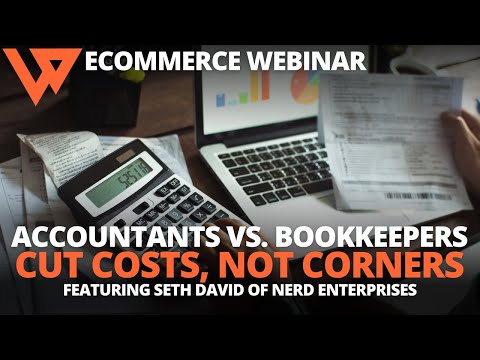
Ecommerce accounting becomes more complex as a business adds sales channels, inventory, payment gateways, taxes, and marketplace payouts. This webinar explains the difference between accountants and bookkeepers, when to hire each professional, what skills to look for, and how accounting automation can reduce manual work.
- Understand the difference between an ecommerce accountant and bookkeeper.
- Learn which financial tasks are typically handled by a bookkeeper.
- See how accountants use financial data for budgeting, tax compliance, cost analysis, and strategic planning.
- Understand the role of controllers and CFOs as ecommerce businesses grow.
- Learn when a business can manage bookkeeping internally and when it should hire professional help.
- Discover why ecommerce accounting is more complex than accounting for a service business.
- Understand how inventory, sales tax, marketplaces, payment gateways, and multiple channels affect financial reporting.
- Learn what questions to ask before hiring an accountant or bookkeeper.
- See how Ecommerce Accounting Automation can reduce transaction entry and reconciliation work.
- Understand why accurate channel-level reporting is essential for evaluating profitability.
Ecommerce Bookkeeping: When to Hire a Bookkeeper or Accountant
Running an ecommerce business involves far more than recording sales and checking a bank balance. As a company adds Shopify, Amazon, Walmart, eBay, POS systems, payment gateways, inventory, refunds, and sales tax obligations, its financial operations become increasingly difficult to manage.
This webinar explains the difference between Ecommerce Bookkeeping and ecommerce accounting, helping business owners determine which type of financial professional they need.
A bookkeeper generally manages the day-to-day financial records of a business. Their responsibilities may include recording transactions, reconciling accounts, managing payroll and expenses, invoicing customers, and preparing financial reports. For ecommerce businesses, this often means collecting data from multiple sales channels and ensuring the transactions are recorded accurately in one system.
An accountant usually takes that information further.
Accountants analyze financial data, prepare budgets, support tax filing and regulatory compliance, perform cost analysis, and help business owners make larger financial decisions. As a company grows, it may also introduce a controller to oversee accounting operations or a CFO to manage forecasting, budgets, benchmarks, and long-term financial strategy.
A small ecommerce business may not need to hire someone immediately. Business owners can often use free tools, accounting software, and Ecommerce Accounting Automation to manage their financial records during the early stages. A connector that transfers orders and expenses into QuickBooks can significantly reduce manual work and delay the need for a full-time bookkeeper.
However, the need for professional support increases as the business becomes more complex.
A bookkeeper may be the right first hire when transaction volume increases, the business operates multiple stores, reconciliation is falling behind, or the owner wants to spend more time on products, sales, and marketing. An accountant becomes more valuable when the business needs help understanding cash flow, making growth decisions, preparing taxes, securing funding, or evaluating profitability.
Ecommerce creates several challenges that do not exist in simpler businesses. Sellers may have to track inventory and Cost of Goods Sold, calculate sales tax across states, manage marketplace settlements, and reconcile different payout reports from Amazon, Shopify, and eBay. Every channel may use different fees, settlement schedules, and payment gateways.
This is why Multichannel Ecommerce Accounting requires both the right expertise and the right technology.
With Shopify QuickBooks Integration, Amazon QuickBooks Integration, QuickBooks Inventory Sync, and Order-level Reconciliation, ecommerce businesses can reduce manual entry and build a more accurate financial record. Automation does not replace the accountant or bookkeeper. It gives them cleaner data and more time to focus on analysis, reporting, and decision-making.
When hiring, look for someone who understands ecommerce workflows, communicates clearly, offers transparent pricing, and is honest about their experience. Referrals are useful, but business owners should still ask about the professional's technology stack, industry specialization, availability, and approach to inventory, reconciliation, and sales tax.
The right combination of automation and human expertise helps ecommerce businesses maintain accurate books, understand profitability, and scale with greater confidence.
What is the difference between an ecommerce bookkeeper and an accountant?
An ecommerce bookkeeper manages daily financial records, including transactions, reconciliation, payroll, expenses, and reports. An accountant analyzes those records, handles tax and compliance matters, and helps guide financial decisions.
When should an ecommerce business hire a bookkeeper?
Consider hiring a bookkeeper when transaction volume becomes difficult to manage, reconciliations are delayed, you operate multiple channels, or bookkeeping takes time away from growing the business.
When does an ecommerce business need an accountant?
An accountant becomes important when the business needs tax guidance, cash flow analysis, budgeting, financial strategy, funding support, or help evaluating profitability.
Why is ecommerce accounting more complicated?
Ecommerce businesses must manage inventory, Cost of Goods Sold, sales tax, marketplace fees, refunds, payment gateways, settlements, and transactions from multiple sales channels.
Can ecommerce accounting software replace a bookkeeper?
Software can automate transaction entry, inventory updates, reconciliation, and reporting, but a bookkeeper or accountant is still valuable for reviewing accuracy, resolving exceptions, and interpreting financial data.
Watch More





Find out what your operational gaps are actually costing you.
Our team of experts will help surface your operations and finance concerns. In 30 minutes, we will discuss your channels, accounting setup, leakages, inventory inconsistencies, and close process.