Enter your email to watch


Do You Need a Bookkeeper, an Accountant, or Both?
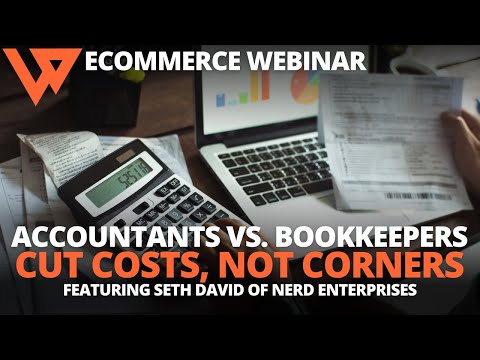
As your ecommerce business grows, managing finances becomes increasingly complex. This partner webinar explains the roles of bookkeepers, accountants, controllers, and CFOs, helping ecommerce business owners understand when to hire financial expertise, automate accounting, and build systems that support long-term growth.
- The difference between ecommerce bookkeepers and accountants.
- When businesses should hire a bookkeeper versus a CPA.
- Why ecommerce accounting is more complex than traditional bookkeeping.
- Understanding sales tax, inventory accounting, and settlement reconciliation.
- Common financial mistakes growing ecommerce businesses make.
- How to hire the right ecommerce accounting professional.
- Why accurate financial reporting improves business decisions.
- The role of accounting automation in scaling ecommerce operations.
- Managing multichannel accounting across Shopify, Amazon, eBay, and retail.
- Building an ecommerce finance stack that grows with your business.
Ecommerce Bookkeeping vs Accounting: What Every Growing Business Should Know
As ecommerce businesses grow, financial management quickly becomes more complicated than simply recording sales and expenses. Multiple sales channels, inventory, taxes, marketplace fees, payment processors, and settlement reports create layers of complexity that many business owners underestimate.
This partner webinar from Webgility and Nerd Enterprises explains the differences between bookkeeping and accounting while helping ecommerce businesses understand when it's time to hire financial expertise.
The webinar begins by defining the role of an ecommerce bookkeeper. Bookkeepers focus on recording transactions, reconciling accounts, managing payroll, organizing expenses, invoicing customers, and maintaining accurate financial records. Their primary responsibility is creating a clean financial foundation that allows business owners to understand where money is coming from and where it's being spent.
Accountants build on that foundation by analyzing financial information, preparing budgets, handling tax compliance, providing strategic guidance, and helping businesses make informed financial decisions. As organizations continue growing, these responsibilities often expand further through controllers and Chief Financial Officers (CFOs), who oversee forecasting, financial planning, internal controls, and long-term business strategy.
One of the webinar's biggest messages is that businesses don't always need to hire immediately. Early-stage entrepreneurs can often manage basic bookkeeping themselves by leveraging Ecommerce Accounting Automation and accounting software like QuickBooks. However, once multiple sales channels, inventory, or complex financial reporting become difficult to manage, hiring a dedicated bookkeeper becomes a worthwhile investment that allows owners to focus on sales, marketing, and business growth.
The discussion also explains why ecommerce accounting is significantly more complicated than traditional service-based businesses. Online sellers must manage inventory valuation, Cost of Goods Sold (COGS), marketplace fees, settlement reports, payment gateways, sales tax compliance, and multichannel reconciliation across platforms such as Shopify, Amazon, Walmart, and eBay. Without accurate bookkeeping, business owners often struggle to understand profitability, cash flow, or inventory performance.
Choosing the right accounting professional is equally important. Rather than selecting someone based solely on price, businesses should look for accountants who understand ecommerce workflows, inventory management, QuickBooks, sales tax compliance, and marketplace accounting. Experience with ecommerce platforms and modern accounting technology often delivers significantly more value than traditional accounting experience alone.
The webinar concludes by emphasizing that accurate financial records create better business decisions. Integrating ecommerce platforms with accounting software through QuickBooks Ecommerce Accounting and automation tools helps businesses centralize orders, settlements, taxes, and inventory into a single financial system. With reliable data, owners can confidently evaluate profitability, plan future growth, and scale without losing visibility into their finances.
What is the difference between an ecommerce bookkeeper and an accountant?
Bookkeepers record and reconcile financial transactions, while accountants analyze financial data, prepare taxes, develop budgets, and provide strategic financial guidance.
When should an ecommerce business hire a bookkeeper?
Businesses should consider hiring a bookkeeper once financial management becomes too time-consuming or complex, especially when managing multiple stores, inventory, or growing sales volumes.
Why is ecommerce accounting more difficult than traditional accounting?
How do I choose the right ecommerce accountant?
Look for professionals with ecommerce experience, knowledge of QuickBooks, inventory accounting, sales tax compliance, and multichannel marketplace integrations rather than general accounting experience alone.
How does Webgility help ecommerce accountants and bookkeepers?
Webgility automates Ecommerce Accounting Automation by syncing orders, settlements, inventory, taxes, and financial data into QuickBooks, reducing manual bookkeeping while improving reporting accuracy for accountants and ecommerce businesses.
Watch More



Find out what your operational gaps are actually costing you.
Our team of experts will help surface your operations and finance concerns. In 30 minutes, we will discuss your channels, accounting setup, leakages, inventory inconsistencies, and close process.