
|
Key takeaways:
|
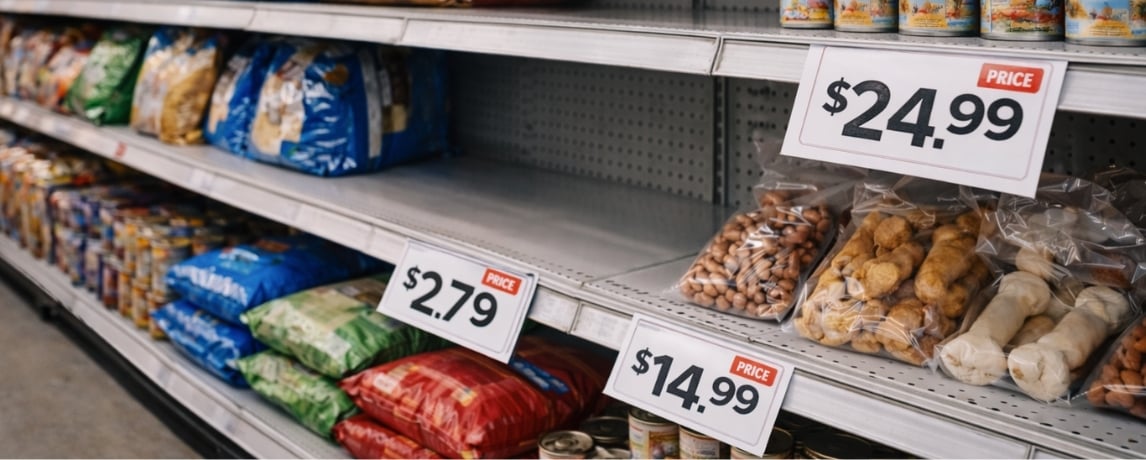
Pet food prices have surged by as much as 73% in just seven months, sharply increasing the cost of feeding dogs and cats and putting new pressure on households already stretched by inflation and tariffs.
While the ‘To Vima’ story highlights dramatic price jumps in Europe, similar forces are now at play in the United States, where trade policy changes and escalating tariff rates are pushing up costs across the pet food supply chain.
This isn't just a ripple in the global trade pool; it is a direct hit to the $157 billion US pet industry.
Whether you are an ecommerce seller looking for a sustainable path forward or a pet owner trying to budget for your dog's favorite kibble, understanding the new tariff landscape is no longer optional.
In this blog, we'll break down what's happening with pet food tariffs right now, which products are most affected by duties, and what businesses can still sell profitably despite the challenging tariff environment.
The pet food tariff crisis hitting US pet businesses
The tariff escalation timeline
US tariffs aren’t new but what’s changed is how fast they can stack in the pet space, turning a manageable duty into a major cost hit once you add up materials and finished goods.
|
A clear example comes from pet product manufacturer DIGGS: the effective tariff burden on its core products rose from 3.4% (2017) to 28.4% (2019) and as high as 73.4% with newer China + steel/aluminum tariffs. The financial impact is staggering: tariff costs jumped from $2,000 to $25,000 per typical shipment, with an increase of $23,000. Israel Maynard, DIGGS COO, said that “It causes us to have to make choices every week on our payables. We've had to have some very uncomfortable conversations with our key partners." The consequences have been brutal:
"The lack of clarity is really dangerous for businesses like ours," Maynard said. "It's really hard to see what the endgame looks like." This example illustrates the devastating math! |
While that figure is product-specific (dog crates), it illustrates a broader reality: pet brands and retailers often face tariffs at multiple points, starting from components, packaging, and finished products, which ultimately pushes up consumer prices.
Separately, broader tariff actions of about 25% on steel and aluminum have also returned to the spotlight in early 2025, creating cost pressure for packaging and pet products that rely on metal inputs.
How big is the problem?
Even if most pet food is made domestically, the U.S. still imports large volumes of finished product and relies heavily on cross-border trade and inputs.
- In 2023, the United States imported $1.71B worth of dog and cat food put up for retail sale totaling 313,624,000 kg
- On the consumer side, rising costs are already a concern: 52% of pet parents are concerned tariffs will stretch pet ownership costs further, and 28% worry about being able to afford pet products, according to Rover’s True Cost of Pet Parenthood Report 2025
- In a poll, 40% expected a significant impact, 20% expected severe impact, and only 13% expected little/no impact.
Which products are most affected?
Industry sentiment suggests pet food makers are bracing for the biggest disruption—especially where imports or global inputs matter.
1) Pet food/treats were identified as the category most impacted at 37% compared to 25% for pet toys and training products.
2) Key ingredients create hidden vulnerabilities. Critical pet food components like vitamin E and essential amino acids are heavily sourced from China. These specialized ingredients have limited alternative suppliers, making them particularly susceptible to tariff-driven price shocks. The animal food industry imported approximately $549 million in ingredients and products from China in 2024, according to the AFIA.
3) Packaging materials represent another pressure point. Aluminum cans for wet pet food, often imported from Canada, have seen cost increases due to metal tariffs. Pet Food Processing reports that the pet food industry utilizes roughly 7 million metal food cans annually, with approximately 25% of these being steel and typically used for dog food, and 75% being aluminum and normally used for cat food.
The hidden stockpile delaying impact
Here's what many pet owners don't realize: they haven't felt the full impact yet.
Anticipating tariff increases in late 2024 and early 2025, major retailers and distributors stockpiled three to six months of inventory, according to the Global Times. Chinese suppliers reported exceptionally high order volumes in Q1 2025 as US buyers rushed to secure products before tariff rates took effect. Industry sources noted that this strategic stockpiling has created an artificial calm in the market.
Consumer ‘buy-ahead’ behavior also shows up during tariff scares (one survey cited in PetfoodIndustry’s May 2025 coverage found 27% of U.S. adults made or planned purchases because they expected tariff-driven price increases).
| The current scenario: The pressure is building even if the checkout sticker shock is uneven today. |
The real-world consequences are already here
Small businesses getting crushed first
When tariffs rise, bigger brands tend to have more shock absorbers: larger cash reserves, longer-term supplier contracts, diversified manufacturing footprints, and the ability to negotiate freight and packaging costs at scale.
Smaller and mid-sized pet companies don’t get those luxuries, yet they still have to operate inside a market where pet spending is massive ($152B in U.S. pet industry expenditures in 2024), as per APPA.
Here are some major challenges faced by small and mid-sized brands:
- Cash flow strain: Tariff payments are due immediately upon import, creating liquidity crunches before products even reach shelves. Companies have to choose between paying suppliers, making payroll, or covering tariff bills
- Volatile landed costs: With tariff rates changing frequently and retroactively, businesses can't accurately forecast costs. A shipment ordered at one rate may arrive under different tariff conditions
- Pricing uncertainty: Should companies absorb costs and sacrifice margins, or raise prices and risk losing customers? Either choice carries significant risk in an inflation-weary market
Price increases are inevitable and coming soon!
Ernie Tedeschi, director of economics at Yale's Budget Lab, calculated a 19% average tariff on imported pet food translates to approximately a 0.75% price increase. While that sounds modest, it's a conservative estimate that doesn't account for compounding effects.
The reality on the ground is harsher. The Global Times reports that Chinese suppliers of premium smart pet products are "scaling back coupons and discounts on US e-commerce platforms, which, frankly, is just a price hike in disguise," according to one exporter named Zhang. The costs inevitably pass to American consumers.
Companies are already implementing price increases. Pet Food Processing notes that aluminum packaging costs are rising sharply, with potential 50% tariffs threatening the 7 million metal food cans the pet food industry uses annually. Sean Connolly, CEO of Conagra Brands, stated at a May 2025 investor forum: "We can't get all of our materials from the United States because there's no supply."
The supply chain reality: No easy alternatives
Moving production to the USA isn't just expensive; it takes significant time, money, and still carries risk. The US Chamber article on DIGGS explains why domestic manufacturing isn't viable for complex products: dog crates aren't just steel, they're steel plus aluminum plus injection-molded plastic components. Building that integrated supply chain from scratch would require massive capital investment.
Meanwhile, U.S. steel prices are roughly double those overseas, driven largely by the 50% steel tariff, making domestic sourcing economically impractical for many products.
Companies exploring alternatives to China face a catch-22. Vietnam and Cambodia offer lower labor costs, but they too face tariff uncertainty. Thus, all ecommerce sellers must find and source all those parts in the U.S. and a cost where the math works.
Export business also taking a hit
The U.S. is a net exporter of pet food – about $2.5B exported annually vs. $1.5B imported, with 50% of exports going to Canada, 10% to Mexico, and the other 10% to China, making retaliatory tariffs a real threat to competitiveness.
| "With over half of those exports going to Canada and Mexico and the remainder to markets that may impose retaliatory tariffs; there's a real risk of eroded competitiveness abroad," Tedeschi warned." |
The broader animal food industry faces similar risks. The American Feed Industry Association notes the industry exported $1.27 billion to China in 2024; however, exports are now threatened by retaliatory tariffs.
Moreover, tariffs tend to push up the US dollar, further hindering exports by making them more expensive globally.
Bonus read: The 2025 Tariff Tsunami: What eCommerce Sellers Need to Know (and How to Stay Profitable)
How pet food businesses can adapt in a tariff-heavy environment
What pet food brands are doing to survive tariffs
- Diversifying suppliers (with limits)
Brands are spreading sourcing across countries to reduce risk, but true diversification is limited. Many ingredients and inputs are still concentrated in a few regions, and switching suppliers often raises costs or disrupts consistency - Reformulating products without sacrificing nutrition
Some brands are tweaking formulas to reduce exposure to tariff-heavy ingredients, while keeping nutritional standards intact. The goal is small, smart substitutions, not cheap fillers that compromise quality - Adjusting packaging formats
To offset higher material costs, brands are redesigning packaging: using lighter materials, less metal, or more efficient pack sizes without changing what’s inside - Raising prices strategically (not universally)
Instead of raising prices across the board, brands are selectively increasing prices on specific SKUs or sizes where customers are least sensitive, helping protect demand and sales - Increasing transparency with customers
Tariff uncertainty is creating more consumer questions so brands are getting clearer about sourcing, country of origin shifts, and what’s driving price changes - Smarter buying strategies (subscriptions & bulk timing)
Both brands and consumers are leaning into subscriptions, bulk production runs, and better inventory timing to reduce per-unit costs and smooth price swings
Top 5 pet product categories to sell under US tariffs
1. US-manufactured premium pet food
Why it works: Zero import tariffs combined with strong "Made in USA" consumer appeal creates a powerful competitive advantage. Domestic production avoids the 19-73% tariff burden entirely while tapping into patriotic purchasing preferences.
Market validation: According to APPA's 2025 Dog & Cat Report, 41% of dog owners and 38% of cat owners purchased premium food in 2024, representing 5% and 9% increases respectively from 2023. Premium purchases rebounded strongly after declining in 2023.
Tariff advantage: Competitive pricing versus tariffed imports. As imported pet food faces 19%+ tariffs, domestic manufacturers can offer similar quality at better price points or maintain higher margins.
Examples: American-made kibble, grain-free options, limited ingredient formulas, specialty diet lines.
2. Raw & freeze-dried pet food
Why it works: Often domestically produced with minimal import exposure. This premium category targets health-conscious owners less sensitive to price increases.
Market validation: The freeze-dried pet food market is experiencing explosive growth. Market research shows frozen and freeze-dried pet food unit sales increased from 15.8% to 18.6% respectively in 2024. The global market reached $35 billion in 2024 and is projected to grow at 4.83% CAGR through 2032.
Tariff advantage: Minimal import exposure as many leading brands (Stella & Chewy's, Primal Pet Foods, Vital Essentials) manufacture domestically or source primarily from North America.
Examples: Freeze-dried raw, air-dried, dehydrated complete meals, raw frozen patties.
| A quick fact: Premium positioning with 30-40% higher margins provides a cushion to absorb any input cost increases without pricing out consumers. |
3. Pet supplements & functional treats
Why it works: High-margin products with smaller package sizes mean value-to-weight ratio minimizes tariff impact. Even if ingredients face tariffs, the premium pricing absorbs costs.
Market validation: APPA's 2025 report shows pet supplements remain a top priority, fueling growing demand year-over-year for vitamins and supplements that support their pets’ well-being. For dogs, joint health/mobility, multivitamins, and skin/coat supplements lead purchases. For cats, multivitamins and pre/probiotic supplements are most popular.
Tariff advantage: High value-to-weight ratio means even tariffed ingredients have minimal per-unit impact on retail price.
Examples: Probiotics, joint support, omega-3 supplements, dental chews, calming treats, digestive enzymes.
| 💡Pro tip: 50-60% margins provide a significant cushion for cost increases while remaining accessible to consumers. |
4. Subscription-based pet food services
Why it works: Recurring revenue and predictable cash flow help weather uncertainty. Subscriptions allow bulk ordering and cost averaging across tariff fluctuations.
Market validation: According to APPA data, Gen Zers (61%) and Millennials (59%) lead subscription purchases, but growth among Gen Xers (+5% to 47%) and Boomers (+4% to 39%) shows broadening adoption across demographics.
Actionable strategy: Lock in customers before stockpiles run out (mid-2026). Subscriptions signed now capture customers at current pricing before major tariff increases hit.
Examples: Monthly delivery boxes, auto-ship programs, customized meal plans, breed-specific subscriptions.
| 💡Pro tip: Customer lifetime value offsets short-term tariff costs. A subscriber paying $60/month for 18 months ($1,080 lifetime value) justifies higher customer acquisition costs and thin initial margins. |
5. Private label & store brand pet food
Why it works: Direct control over sourcing, margins, and pricing. Retailers can strategically source from lower-tariff countries or domestic suppliers while capturing higher margins than carrying national brands.
Market validation: APPA's 2025 data indicates consumers are trading down with 26% of dog owners and 38% of cat owners purchasing basic/generic food in 2024. While premium gains share, the value segment remains substantial.
Tariff advantage: Flexibility to pivot sourcing strategies quickly without brand reputation constraints. Can blend domestic and imported ingredients to optimize costs.
Examples: Retailer-branded dry food, house-brand treats, generic alternatives, store-exclusive formulations.
| A quick fact: Higher margins than national brands (typically 25-35% vs 15-20%) provide pricing flexibility. Retailers can undercut branded competitors while maintaining healthy profits. |
Implementation Strategy for Ecommerce Sellers
Immediate actions (Q1 2026):
- Audit current product mix for tariff exposure
- Diversify toward low-tariff categories identified above
- Establish relationships with US-based manufacturers
Q2 2026:
- Build inventory of US-made products before tariffed product stockpiles run out
- Test subscription offerings to build recurring revenue
- Develop private label partnerships if selling through owned channels
H2 2026 and beyond:
- Position for increased demand as tariffed products experience price increases
- Market domestic sourcing and tariff-free positioning as competitive advantages
- Track tariff-driven cost changes at the SKU level (landed cost, packaging, ingredient exposure) so you know which products still contribute margin when pricing and promotions change. (This is where ecommerce automation solution like Webgility can help)
What comes next for pet food tariffs?
1. Continued policy volatility
With 2026 midterm elections approaching, trade policy remains a primary negotiating tool. This ‘negotiation-by-tariff’ approach means rates could fluctuate with little notice, making it nearly impossible for brands to rely on a single international source.
2. The USMCA review
A big deadline is coming up in 2026, when the United States–Mexico–Canada Agreement (USMCA) goes up for formal review. That matters a lot for this industry because Canada and Mexico are the two biggest buyers of U.S. pet food. If the review triggers trade tensions and retaliatory tariffs, it could put a huge chunk of business at risk; potentially half of the industry’s roughly $2.5B export market.
Act now: Your pet food tariff survival strategy!
Pet food tariffs are no longer temporary market noise, they have become a structural cost factor that is fundamentally reshaping the US pet industry.
What you should do next:
- Ecommerce sellers: Audit your product mix now. Identify your high-tariff vulnerabilities and begin shifting your marketing and inventory spend toward domestic or high-margin ‘tariff-resistant’ categories
- Pet owners: Plan ahead. Stock up on essentials, consider subscription services for predictable pricing, and explore domestic alternatives (Made in USA) before tariffed products become unaffordable.
The winners won't be the largest companies or those with the deepest stockpiles. They'll be the brands that understand their costs at the order, product, and margin level, and adapt accordingly. Are you one of them?

-3-2.webp?width=760&name=2%20(1)-3-2.webp)
-2.webp?width=760&name=1%20(2)-2.webp)