.png?width=96&name=image%20(9).png)
|
Key Takeaways
|
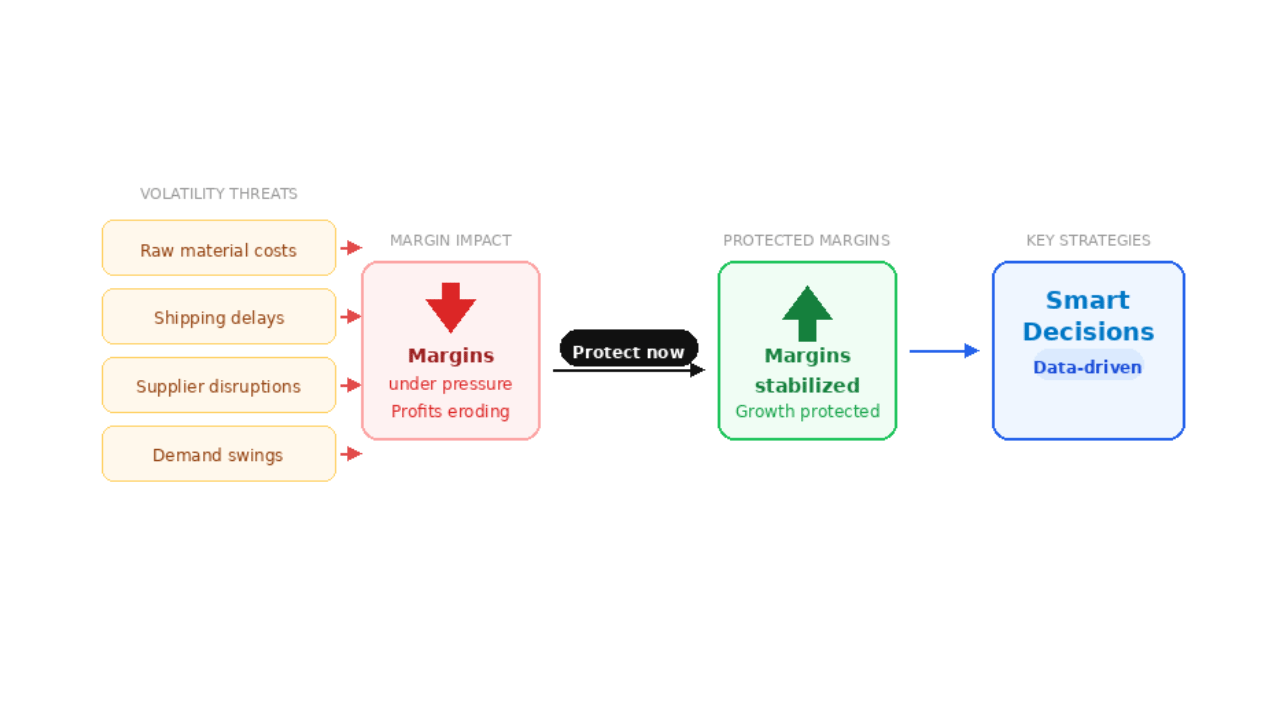
Strong sales no longer guarantee healthy margins. In 2026, supply chain pressure is coming from multiple directions at once: rising delivery costs, higher fuel-linked freight expenses, supplier price increases, and conflict-driven shipping disruptions that continue to push vessels onto longer, more expensive routes around the Cape of Good Hope.
Crude oil and petroleum product prices also rose sharply in the first quarter of 2026, adding more pressure to transportation and fulfillment costs. The result is a business that can look strong on revenue while quietly losing profitability.
That is why margin protection now requires smarter operational moves, not just higher prices.
Here are 10 strategies to fix that, including a few unconventional ones most sellers overlook.
Why supply chain volatility hits margins so hard
Supply chain volatility creates pressure from multiple directions at once:
- Rising delivery costs and unpredictable freight surcharges
- Increasing supplier and raw material prices
- Higher warehousing and inventory carrying costs
- Delays that force expensive rush shipping or lead to lost sales
- Returns and fulfillment inefficiencies
- Reactive discounting to maintain sales volume
The operators who protect themselves aren't the ones who find one big fix, they're the ones who close ten small leaks.
Top strategies to protect margins amid supply chain volatility
None of these require a bigger budget, just a sharper look at where the money is actually going:
1. Shrinkflation- The brand-safe margin move
Shrinkflation is the practice of maintaining your price point while slightly reducing the quantity, weight, or bundle size of a product. CPG giants have used this tactic for decades, and ecommerce sellers can too.
Instead of raising prices, you:
- Reduce bundle size
- Lower unit count
- Slightly decrease product weight (oz/ml)
- Simplify packaging or included extras
For ecommerce sellers, this can look like:
- Turning a 5-pack into a 4-pack at the same price
- Repositioning products as “single-use” or “trial-friendly”
- Offering “compact” or “travel-size” versions
The key is framing: "premium single-serve" lands very differently than "we cut the pack."
⚠️ Caution: Loyal customers notice changes quickly. If overused or poorly framed, shrinkflation can erode trust. Use it strategically, not as a default move.
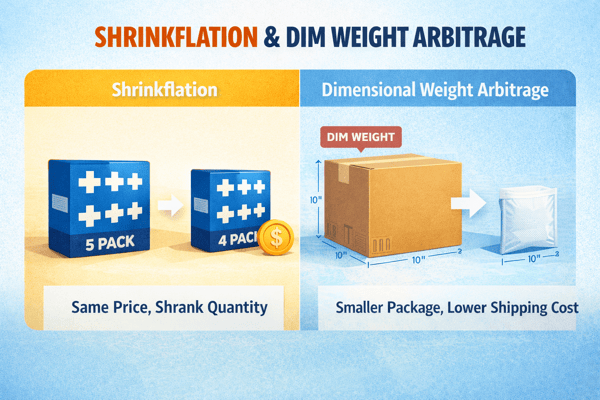
2. Dimensional weight arbitrage- Your packaging is probably costing you
Here’s something most sellers overlook:
Your biggest shipping cost issue might not be your carrier, it’s your packaging.
Carriers price shipments based on dimensional (DIM) weight, not just actual weight. That means:
- Oversized boxes = higher shipping costs
- Inefficient packaging = wasted margin
Small changes can have outsized impact:
- Switching box sizes
- Using poly mailers instead of rigid packaging
- Reducing empty space in shipments
Many businesses reduce per-unit shipping costs by 15–25% just by optimizing packaging.
In many cases, rising delivery costs are actually a packaging problem in disguise.
3. SKU review- Kill the products quietly killing you
Your bestselling product might be your worst-margin product. Volume and margin are not the same thing, and treating them as equivalent is one of the most common and costly mistakes in ecommerce.
To evaluate properly, calculate true contribution margin:
Selling price – COGS – platform fees – returns – shipping
Then categorize your SKUs:
- Keep: High margin, strong demand
- Push: Moderate margin, growth potential
- Kill or Fix: Low/negative margin
Most sellers discover that 20–30% of their SKUs are margin-negative once all costs are included.
👉 Removing or fixing these products can improve margins faster than increasing sales.
4. AOV strategy & threshold pricing
If shipping costs are rising, the smartest move isn’t always to charge more, it’s to increase order value.
Start with your free shipping strategy:
- Set thresholds above your break-even AOV, not based on competitors
- Encourage customers to add items instead of absorbing shipping costs
Then optimize bundles:
- Pair a high-margin, low-weight product with a popular item
- Create “value bundles” that increase perceived savings
This does two things:
- Offsets rising delivery costs
- Improves overall margin per order
👉 Done right, customers feel like they’re getting more, while you’re actually protecting profitability.
5. Supplier renegotiation- The conversation most sellers avoid
Many sellers hesitate to revisit supplier contracts, but in volatile markets, it’s expected.
And right now, you have leverage.
Tariffs, currency shifts, and global disruptions give you a legitimate reason to reopen discussions without damaging relationships.
Instead of focusing only on unit price, negotiate:
- Pre-payment discounts
- Volume commitments
- Better payment terms
- FOB (Free On Board) adjustments
👉 Small improvements here compound across every unit you sell.
6. Rethink discounts- Most are eating your margins twice
Discounting feels like a quick win, but it often creates a double hit:
- Reduced selling price
- Unchanged (or increasing) fulfillment and shipping costs
With rising delivery costs, this becomes even more damaging.
- Replace flat discounts with bundle or volume-based offers
- Avoid discounting products already impacted by high shipping costs
- Use gift-with-purchase instead of percentage discounts
👉 You still drive conversions, but protect your margins at the same time.
s are one of the most overlooked margin drains.
They impact:
- Shipping costs (twice)
- Inventory value
- Operational efficiency
- Offer store credit instead of refunds
- Charge return shipping selectively (based on reason)
- Identify and fix products with high return rates
More importantly, identify which SKUs are driving the most returns and fix the root cause. A product with a 20% return rate and rising delivery costs on both legs of the journey is actively destroying margin with every order.
👉 Reducing return leakage can directly improve profitability, without increasing sales.
7. Turn returns into a margin strategy (Not just a cost center)
Returns are one of the most overlooked margin drains.
They impact:
- Shipping costs (twice)
- Inventory value
- Operational efficiency
- Offer store credit instead of refunds
- Charge return shipping selectively (based on reason)
- Identify and fix products with high return rates
More importantly, identify which SKUs are driving the most returns and fix the root cause. A product with a 20% return rate and rising delivery costs on both legs of the journey is actively destroying margin with every order.
👉 Reducing return leakage can directly improve profitability, without increasing sales.
8. Use inventory placement to reduce shipping zones
Shipping distance matters more than ever.
Instead of just managing inventory levels, optimize where inventory is stored:
- Place fast-moving SKUs closer to high-demand regions
- Use 2–3 strategic fulfillment locations
- Avoid long-distance shipping for frequently ordered items
This reduces:
- Transit times
- Carrier costs
- Exposure to rising delivery costs
👉 At scale, smarter inventory placement can significantly improve margins.
9. Cut operational waste before cutting growth
Before raising prices or reducing spend, fix internal inefficiencies.
Common margin leaks include:
- Manual order entry errors
- Duplicate shipping charges
- Incorrect product cost assumptions
- Missed fee reconciliation
- Delayed financial reporting
- Disconnected systems across sales, inventory, and accounting
👉 Some of the biggest margin improvements come from fixing processes, not negotiating costs.
10. Use automation to catch margin leaks early
The biggest challenge in volatile environments isn’t just cost, it’s visibility.
Manual systems delay insights, which means:
- You notice margin erosion too late
- You react instead of proactively adjusting
With automation tools like Webgility, you can:
- Track order-level profitability in real time
- Sync ecommerce, inventory, and accounting data automatically
- Capture fees, shipping costs, and COGS accurately
- Identify margin leaks before they scale
The Hunter Company, a US-based leather goods manufacturer selling across Shopify and QuickBooks, faced exactly this problem, manual data entry across systems was time-consuming and error-prone, with thousands of products requiring precise SKU mapping and barcode syncing.
After implementing Webgility, they saved thousands of hours annually, eliminated double entry, and built a scalable operation that handles high order volumes without adding headcount.
👉 In an environment driven by rising delivery costs, speed of insight is what protects margins.
Protect your margins before volatility decides for you
Supply chain volatility isn’t going away, but margin erosion isn’t inevitable.
From shrinkflation and packaging optimization to smarter pricing and automation, there are multiple ways to protect profitability without sacrificing growth.
3 actions you can take this week:
- Rank your top 10 SKUs by margin, not units sold
- Weigh your 3 most-shipped products against current packaging
- Set a reminder to renegotiate your top supplier contract this quarter
Not sure what your real margins are? That's the first problem to solve. Use Webgility's Profit Leak Detector to find out where you're losing money, and how much.
FAQs
How do rising delivery costs affect profit margins?
Rising delivery costs increase the total cost per order, reducing contribution margin. If not accounted for in pricing or operations, they can turn profitable products into loss-making ones.
How can better inventory management improve margins?
Better inventory management reduces overstocking, stockouts, and unnecessary shipping costs. It also helps optimize fulfillment locations, which lowers shipping expenses and improves profitability.
What are the best ways to reduce supply chain-related margin loss?
Key strategies include optimizing packaging, increasing average order value, renegotiating supplier terms, reducing returns, and improving visibility into true order-level profitability.
.png?width=128&name=image%20(9).png)