.png?width=96&name=image%20(1).png)

Did you know that over 90% of Shopify sellers use two or more sales channels, yet most struggle with inventory mismatches and reconciliation headaches?
"Inventory not tracked" in Shopify can seem like a shortcut until it costs you time, money, or customer trust.
While this setting works for some business models, it can open the door to costly errors as you scale. This guide shows you how to avoid those mistakes, choose the right workflow for your business, and compare the best tools to keep your operations under control.
Why do some brands choose "inventory not tracked" in Shopify
Not every business needs Shopify to track inventory. Here is why some brands opt out.
The "inventory not tracked" setting in Shopify means the platform does not monitor stock levels for selected products. Customers can purchase these items as many times as they want, and Shopify will not block orders even if you have none left in stock.
This approach is a deliberate choice for certain business models where traditional inventory tracking adds unnecessary complexity.
Who uses untracked inventory and why it works for them:
- Print-on-demand brands let suppliers fulfill orders as they come in, so there is no inventory to track
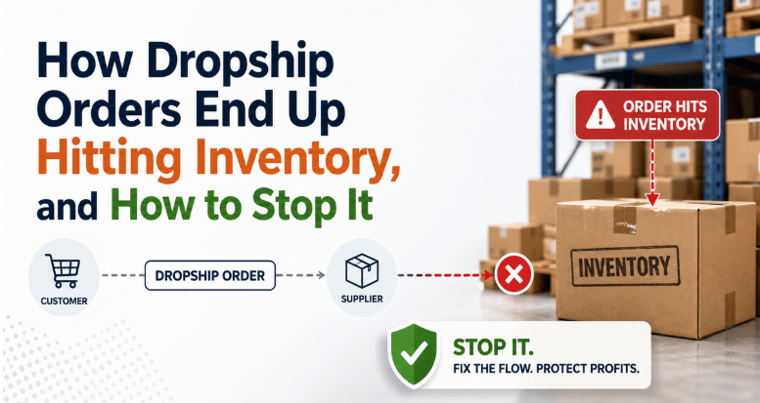
- Dropshippers rely on supplier stock, not their own warehouse counts
- Made-to-order sellers build products only after purchase, making stock tracking irrelevant
- Service providers and digital sellers have no physical inventory to monitor
- Test launch merchants manage limited runs manually while validating new products
For brands processing under 50 orders per day or with a single fulfillment source, untracked inventory often keeps things simple and flexible. The risks are low, and manual oversight is manageable.
However, as brands expand to multiple channels or higher order volumes, untracked inventory can create new challenges. Multi-channel sellers often outgrow Shopify’s default settings and need more robust inventory and accounting sync as they scale.
3 costly mistakes when inventory tracking is off
When you do not track inventory, you risk overselling, reconciliation chaos, and profit blind spots. These issues can quickly erode margins and customer trust, especially as your business grows.
Here are the mistakes that occur:
|
Mistake |
Scenario |
Impact |
|
Overselling |
You sell 50 units on Shopify and 30 on Amazon, but only have 60 in stock |
Refund fees, angry customers, negative reviews |
|
Reconciliation gaps |
The finance team spends 40 hours per month re-entering orders and correcting errors |
Delayed closes, unreliable reports, missed revenue |
|
No channel profitability |
You cannot see which channel is profitable, so ad spend is wasted on losing channels |
Scaled losses, cash flow crunch |
Table: Costs of Untracked Inventory
Epic Mens, a multi-channel apparel brand, saved over 80 hours per week and reduced overselling by automating inventory and accounting sync across Shopify, Amazon, and eBay.
In fact, Webgility customers report saving up to 90% of time on reconciliation and month-end close. These risks can be managed if you audit your process regularly.
Preventing reconciliation errors: Your audit checklist
A disciplined audit process prevents small errors from becoming costly problems. By checking inventory, orders, and accounting records on a set schedule, you can catch discrepancies before they spiral.
Audit checklist
- Weekly:
- Spot-check inventory levels for 10 random SKUs across Shopify, marketplaces, and your warehouse
- Verify that product variants match across all channels
- Monthly:
- Reconcile total orders and payouts to accounting records
- Match refund totals and fees to your books
- Quarterly:
- Audit the cost of goods sold (COGS), marketplace fees, and inventory accuracy
- Review supplier invoices against recorded inventory
If your Shopify payout report shows $50,000 in sales for the month, confirm that your accounting system reflects the same total after accounting for refunds and fees.
Suggested Read: How to Simplify Ecommerce Bookkeeping [2026 Guide]
Choosing your inventory workflow: Single-channel vs. multi-channel
Your workflow should fit your business, not the other way around. The right inventory process depends on your sales channels, order volume, and operational needs. Here is a simple decision tree:
Are you Shopify-only or multi-channel (Amazon, eBay, POS)?
- Shopify-only, under 50 orders/day:
- Manual tracking or the basic Shopify app may suffice
- Weekly spot checks and manual updates keep things in control
- What this means for you: Low cost, low complexity, but limited scalability
- Multi-channel or 50+ orders/day:
- Real-time sync and accounting integration become essential
- Automation tools prevent overselling and reduce manual work
- What this means for you: Higher efficiency, fewer errors, ready to scale
If you use QuickBooks or another accounting system, automated order posting and fee reconciliation are critical for accuracy. Brands with multiple warehouses or 3PL partners need location-aware inventory management.
Suggested Read: QuickBooks Setup
Best apps and automation tools for untracked inventory (feature comparison)
Choose the right tool for your workflow and scale. Not all inventory and accounting apps are created equal.
Here is how leading platforms stack up for untracked inventory management:
|
Platform |
Order-Level Sync |
Real-Time Inventory |
Refunds |
Accounting Integration |
POS Support |
Multi-Channel |
Pricing |
|
Shopify Native |
Limited |
Basic |
Manual |
No |
Shopify POS only |
No |
Free |
|
MyWorks |
Yes |
Limited |
Yes |
QuickBooks, Xero |
No |
Shopify, WooCommerce only |
$19–99/mo |
|
Webgility |
Yes |
Yes |
Yes |
QuickBooks, Xero, NetSuite |
Yes |
Yes (9+ platforms) |
$99+/mo |
|
A2X |
No (payouts only) |
No |
Yes |
QuickBooks, Xero, NetSuite |
No |
Amazon, Shopify, Etsy, eBay |
$29–199/mo |
|
Synder |
Yes |
Limited |
Yes |
QuickBooks, Xero, Sage |
Limited |
Yes (6 platforms) |
$65+/mo |
Table: Inventory Automation Tool Comparison
How Webgility stands out
- Order-level sync, SKU-level margin tracking, QuickBooks integration, and trusted by over 5,000 ecommerce businesses
- 4.6/5 average rating across G2, Capterra, Shopify, and QuickBooks
- Strategic partner of Intuit
- With Webgility, BeeCure reports 40 hours saved every month, with month-end reconciliation going from a week to 1–2 hours, enabled by integration with QuickBooks and automated syncing from Amazon and Shopify.
- Official integrations with QuickBooks and NetSuite
With the right tool in place, you can scale your workflow and unlock new efficiencies.
Suggested Read: Compare A2X alternatives
From manual counts to automated forecasting: Scaling untracked inventory
Scaling requires more than manual counts; automation unlocks forecasting and smarter purchasing.
Real-time inventory visibility supports demand planning and helps prevent stockouts. By automating purchase orders and supplier management, you can keep inventory levels optimized without constant manual intervention.
How much time could you save by automating your workflow?
If your business is growing or selling on multiple channels, now is the time to consider automation platforms like Webgility to keep operations seamless.
To learn more, get a demo.
FAQs
What is the main risk of using "inventory not tracked" in Shopify?
The biggest risk is overselling, especially if you sell on multiple channels. Without tracking, you might sell more units than you actually have, leading to refunds and unhappy customers.
How can I avoid reconciliation headaches with untracked inventory?
Use automation tools that sync orders and accounting data in real time. This reduces manual entry and helps you catch errors before they become costly.
Is it possible to automate inventory updates if Shopify is not tracking inventory?
Yes, third-party apps like Webgility can automate inventory and order syncing across channels, even if Shopify itself is not tracking inventory.
Can I switch from untracked to tracked inventory later?
Absolutely. You can enable inventory tracking in Shopify at any time. Just be sure to audit your current stock and sync data across all channels before making the switch.
.png?width=128&name=image%20(1).png)