.png?width=96&name=image%20(1).png)
|
Key Takeaways:
|
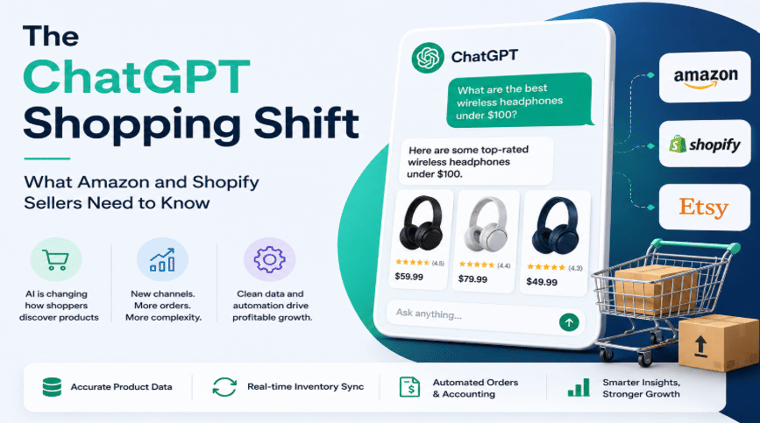
Your next customer might not find you through Google or any other SERP; they might ask ChatGPT for a recommendation instead.
AI-powered search is changing how shoppers discover products. Instead of scrolling through search results, they're asking tools like ChatGPT, Gemini, and Perplexity questions like "What's the best standing desk under $500?" If your store isn't showing up in those answers, you're invisible to a growing segment of buyers.
39% of consumers already use AI tools for product discovery, and that number jumps to over 50% for Gen Z shoppers (Source).
The good news? Most Shopify merchants haven't caught on yet. That's your window.
This guide breaks down 10 practical LLM optimization techniques to help your store get cited, recommended, and discovered by AI, before your competitors figure it out.
What is LLM optimization?
LLM optimization is the practice of structuring your website content, product information, and brand messaging to improve visibility and citations within AI-powered tools and search experiences.
Where traditional SEO asks "How do I rank higher on Google?", LLM optimization asks "How do I get recommended when someone asks an AI assistant for help?"
Why LLM optimization matters for ecommerce and Shopify stores
For ecommerce merchants, LLM optimization is becoming essential for discovery and growth. Here's why:
- Shoppers are shifting to conversational search: More consumers are asking AI tools natural-language questions rather than typing keyword phrases. For example: “What's the best yoga mat for beginners under $50?” is becoming more common than "yoga mat beginner cheap"
- AI recommendations carry weight: When ChatGPT, Gemini, Claud, or Perplexity recommends a specific brand, users tend to trust those recommendations. Being cited by an AI tool can drive significant referral traffic and build brand credibility
- Competition is still relatively low: Most Shopify merchants haven't yet optimized for LLMs, which means early adopters have an opportunity to establish visibility before the space becomes crowded
- AI search is growing across platforms: From Google's AI Overviews to Bing's Copilot to standalone tools like Perplexity, AI-powered search is expanding rapidly. Optimizing now positions your store for where search is heading
Traffic from generative AI tools to ecommerce sites doubled every two months through 2024–2025, with 47% of shoppers using AI specifically for product recommendations.
Now that it’s clear why LLM optimization is becoming essential for Shopify merchants, the next question is simple: what should you actually do? Let’s dive into the most effective, proven tactics you can start implementing today.
Top 10 tips to optimize your Shopify store for LLMs
LLM optimization is more than chasing algorithms. Instead, it’s about making your store easier for AI to understand and recommend. With that foundation in mind, here are the top techniques Shopify merchants can use to stay discoverable as AI-driven search continues to evolve:
1. Implement the llms.txt file
The llms.txt file is an emerging standard that helps AI crawlers understand your website. Similar to how robots.txt guides traditional search engine crawlers, llms.txt provides instructions and context specifically for LLM systems.
What to include in your llms.txt file:
- A brief description of your brand and what you sell
- Key product categories and your unique value proposition
- Links to your most important pages (product collections, about page, FAQ)
- Any specific instructions for how AI should represent your brand
How to implement it:
Create a text file named "llms.txt" and place it in your Shopify store's root directory. You can do this through Shopify's file manager or by editing your theme files. Keep the content concise, accurate, and updated as your store evolves.
This file gives AI systems a clear, condensed summary of who you are and what matters most about your brand, information they can use when formulating recommendations.
2. Create high-quality, informative content
LLMs prioritize content that genuinely helps users, not content written solely to rank. Thin blog posts, repetitive product descriptions, or vague landing pages are unlikely to be referenced by AI tools.
Instead, focus on content that:
- Explains concepts clearly
- Answers specific buyer questions
- Demonstrates subject-matter expertise
For Shopify merchants, this means investing in blog content, buying guides, and educational resources that position your brand as an authority in your niche.
Bonus read: Best Shopify Integrations to Boost Your Store Performance
3. Add schema markup
Schema markup (structured data) helps search engines and AI tools understand exactly what your content represents. It's the difference between an AI knowing a page contains text and knowing that text is a product with a specific price, rating, and availability.
Key schema types for Shopify stores:
- Product schema: Includes name, description, price, availability, brand, SKU, and images
- Review schema: Aggregates customer ratings and individual reviews
- FAQ schema: Structures question-and-answer content
- Organization schema: Provides information about your business
- BreadcrumbList schema: Shows site hierarchy and navigation structure
When AI tools encounter well-marked-up content, they can more confidently extract and cite specific information, like your product's price, features, or customer rating.
4. Create value-driven product descriptions
Your product descriptions shouldn't just list features; they should answer the questions shoppers are asking AI tools.
How to write AI-optimized product descriptions:
- Lead with benefits, not features. Instead of "100% organic cotton," try "Made from 100% organic cotton for all-day comfort and breathability"
- Address common questions. Who is this product for? What problem does it solve? How does it compare to alternatives? Answer these within the description
- Include specific details. Dimensions, materials, care instructions, compatibility, the more specific information you provide, the more context AI tools have to work with
- Use natural language. Write the way your customers talk. If someone asks an AI, "What's a good gift for a home cook who has everything?", your description should include language that matches that conversational query
- Differentiate from competitors. Explain what makes your product unique. Generic descriptions get lost; distinctive ones stand out
Bonus read: Holiday Marketing Campaigns with AI: Top Strategies for 2025
5. Maintain and manage ecommerce inventory and accounting data
LLMs rely on trust signals, not just content. Inconsistent pricing, mismatched product names, inventory discrepancies, or unclear refunds can weaken how AI tools evaluate and recommend your store.
Maintaining accurate inventory and accounting data across your ecommerce stack helps reduce conflicting signals and reinforces credibility. For Shopify merchants, this often means ensuring sales, payouts, fees, and inventory movements stay aligned between storefronts, marketplaces, and back-office systems.
Solutions like Webgility help automate this consistency by keeping ecommerce transactions and financial data in sync, which reduces manual adjustments and preserves a clean, reliable data history over time.
Clean inventory and accounting data don’t just support operations; they reinforce the reliability and consistency AI tools look for when deciding which brands to recommend.
6. Leverage customer reviews and testimonials
Customer reviews provide natural-language context that AI models find extremely valuable. They reflect real-world usage, benefits, objections, and outcomes, often in the same phrasing future buyers use.
Encourage reviews that go beyond star ratings by prompting customers to share:
- Why they chose the product
- What problem did it solve
- How it compares to alternatives
These insights frequently get incorporated into AI-generated summaries and recommendations.
7. Create a comprehensive FAQ section
FAQ pages are goldmines for LLM optimization. They directly mirror how people ask questions to AI tools, and they provide clear, structured answers that AI can easily cite.
Building an effective FAQ section:
- Research actual customer questions. Look at your customer service inquiries, product reviews, and search analytics to identify what people really want to know
- Cover the full customer journey. Include questions about products, shipping, returns, sizing, care, comparisons, and use cases
- Write complete answers. Don't be too brief. Provide enough detail that someone could make a decision based on your answer alone (while keeping it short)
When your FAQs sound like real customer questions, AI tools are much more likely to pull and reuse your answers.
8. Optimize images for AI discovery
AI models increasingly analyze images alongside text to understand products more holistically. Poorly labeled images are a missed opportunity for discovery.
Optimize your images by:
- Using descriptive file names
- Writing meaningful alt text
- Including contextual captions when relevant
- Avoiding generic or auto-generated labels
- Use multiple angles and context shots
This helps AI correctly associate visuals with products, use cases, and categories.
Bonus Read: How to Write Product Descriptions That Sell
9. Build an internal linking strategy
Internal links help both traditional search engines and AI tools understand the relationships between your content. A strong internal linking structure signals which pages are most important and how topics connect.
Internal linking best practices:
- Link to relevant product pages from blog content. If you write a guide about choosing running shoes, link to your running shoe collection
- Connect related products. "Customers also viewed" and "Frequently bought together" sections create useful internal links
- Use descriptive anchor text. "Our collection of organic skincare products" is more informative than "click here"
- Create hub pages. Comprehensive category pages that link to individual products and related content help AI understand your site's structure
- Ensure navigation is crawlable. AI tools need to be able to follow your site's navigation to understand its full scope
10. Monitor and adapt to AI suggestions
LLM optimization isn't a set-it-and-forget-it strategy. AI tools evolve, and your approach should too.
How to monitor and adapt:
- Test AI tools directly. Periodically ask ChatGPT, Gemini, and Perplexity questions about products in your category. See if your brand comes up, and identify how competitors are being cited to fill that gap
- Track referral traffic. Monitor your analytics for traffic from AI sources. While this tracking is still evolving, watching for patterns can provide insights
- Stay informed. Follow industry latest trends, news about AI search developments, algorithm changes, and emerging best practices
- Iterate on content. If certain content isn't getting cited, revisit it. Is it comprehensive enough? Clearly structured? Differentiated?
- Gather feedback. Pay attention to how customers say they found you. If AI recommendations are driving awareness, double down on what's working
The future of LLMO for Shopify merchants
LLM Optimization isn’t a trend, it’s a shift. The AI in the ecommerce market is rapidly expanding, projected to be worth $11.2 billion+ in 2026, up from ~$9 billion in 2025, and expected to surge further in the decade ahead.
In the future:
- AI answers will influence buying decisions more than rankings
- Brand mentions will matter as much as backlinks
- Structured, trustworthy content will outperform keyword-heavy pages
Merchants who adapt now will compound visibility over time.
Ensure your Shopify store is AI-ready by 2026
As AI tools become a primary way shoppers discover products, having a well-optimized Shopify store is only part of the equation. You also need accurate, detailed product data flowing consistently across all your channels. This is where Webgility helps Shopify merchants:
- Sync orders, fees, and payouts accurately
- Maintain clean, structured financial data
- Ensure consistency across sales channels
Clean data doesn’t just help accounting; it strengthens trust signals that AI tools rely on. When your operations run smoothly behind the scenes, you can focus on creating the kind of high-quality content and customer experiences that AI tools want to recommend.
Brands like Skinny Mixes chose Webgility to accelerate their Shopify growth 🚀
Skinny Mixes, a low-calorie beverage brand, used Webgility to bridge the gap between its Shopify store and its back-office operations. By automating their data sync, they were able to increase:
- Revenue: Online revenue doubled, adding over $3M in annual revenue
- Volume: Order volume rose 75% YOY
- Efficiency: Freed up operational time to recover 19% of abandoned carts
Final thoughts: Get discovered by AI, not just SERPs
AI search isn't replacing Google overnight, but it's already influencing how shoppers discover and trust brands. The Shopify merchants who invest in LLM optimization techniques now will build visibility that compounds over time, while competitors scramble to catch up.
Start small, implement your llms.txt file, tighten up your product descriptions, and structure your FAQs for conversational queries. These foundational moves position your store for where search is heading.
And remember, AI tools favor brands with clean, consistent data. That's where Webgility comes in. By automating your Shopify data: managing inventory and keeping your financial data accurate across all sales channels, you free up time to focus on customer experiences that help you get recommended.
Book a demo with Webgility today!
FAQs
How to maximize LLM performance?
To ensure AI tools recommend your store accurately, keep your data fresh and consistent across the web. High site speed, clear content hierarchy (H1-H3), and regular updates to pricing and inventory help AI models trust your site as a reliable, real-time source of information.
How to optimize content for LLMs?
Shift to conversational, intent-based writing. Use a "Question-Answer" format in your FAQs, lead with direct answers at the top of sections, and replace vague marketing fluff with specific, quantifiable data (e.g., "12-hour battery life" instead of "long-lasting").
Which technique helps improve LLM output quality?
Retrieval-Augmented Generation (RAG) improves LLM output quality by letting the AI pull in real, up-to-date information before responding. This helps reduce guesswork, improve accuracy, and make answers more relevant, reliable, and easier to trust.
.png?width=128&name=image%20(1).png)