.png?width=96&name=image%20(2).png)
|
Key Takeaways
|
Amazon just made it more expensive to sell on its platform, again.
Starting April 17, 2026, Amazon applied a 3.5% (Source) fuel and logistics surcharge to FBA fulfillment fees across the US and Canada, on top of an average $0.08 per-unit increase already in place.
Hundreds of large sellers responded with a 24-hour advertising boycott, organized by Million Dollar Sellers, a community generating $14 billion in combined revenue. The sentiment was blunt: "We're running out of margin." (Source)
To put it in real numbers: a $15 product absorbs $0.12 extra per unit; a $50 item, $0.25 or more. Sell at volume and that compounds fast.
The sellers who weather this best are the ones who act on better data, faster. This guide covers exactly how.
What changed with Amazon FBA fees in 2026
Amazon’s 2026 US update says FBA fees rose by an average of $0.08 per unit sold. Amazon also states that this is less than 0.5% of an average item’s selling price.
Then came the bigger headline: Starting April 17, 2026, Amazon applied a 3.5% fuel and logistics-related surcharge to FBA fulfillment fees in the US and Canada.
Why should sellers care? Because these are direct margin hits. For sellers, this isn't just a line item to note, it's a signal to revisit every SKU's true cost structure and reassess which products are still worth selling under the new economics. A seller moving 10,000 units a month does not experience this as a minor update. They experience it as thousands of small cost increases stacked on top of ad spend, returns, storage, and cost of goods.
How rising FBA costs shrink seller margins
Higher fulfillment costs don't just eat into one line item, they create pressure across the entire business:
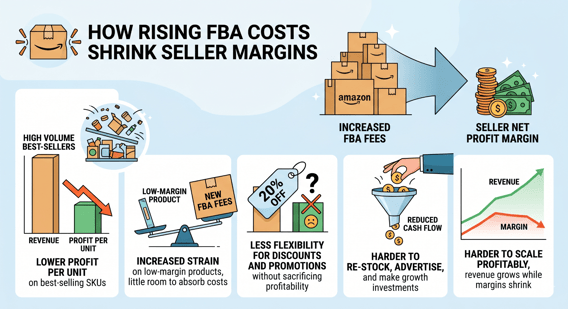
- Lower profit per unit on your best-selling SKUs, where volume makes every cent matter
- Increased strain on low-margin products that had little room to absorb cost increases to begin with
- Less flexibility for discounts and promotions without sacrificing profitability
- Reduced cash flow available for restocking, advertising, and growth investments
- Harder to scale profitably, revenue can grow while margins quietly shrink
5 steps to protect your margins as Amazon FBA costs rise
As Amazon FBA fees continue to rise, these five practical steps can help you stop guessing, protect profitability, and make smarter decisions with more confidence:
Step 1: Measure true profitability at the SKU level
Revenue is not profit. This is obvious in principle and routinely ignored in practice.
To actually know which products are worth selling under the new cost structure, sellers need to track, per SKU: cost of goods sold, FBA fulfillment fees (including the surcharge), storage costs, advertising spend, returns and refunds, and any inbound shipping or prep costs. The total gives you a contribution margin, the number that tells you whether a product is actually worth the shelf space.
Without that number, sellers are guessing. And under rising fee conditions, guessing is how healthy businesses slowly become unprofitable ones.
Step 2: Reprice strategically, not reactively
The instinct when costs rise is to immediately raise prices. Sometimes that's right. Often it's more complicated.
The better approach is to evaluate whether fee increases on a specific SKU justify a price change, and what the Buy Box implications of that change are. Raising a price by $0.50 on a high-velocity item to preserve margin is very different from chasing a competitor to the bottom with discounts on a product that's already borderline.
For some products, the honest conclusion after running the math is that they're no longer worth selling at current price points. Identifying those products proactively, rather than continuing to fulfill them at a loss, is how sellers protect the overall health of the business.
Step 3: Clean up your inventory strategy
Slow-moving inventory is expensive in normal times. Under higher FBA fees, it's a compounding problem. Storage charges accumulate, long-term storage fees kick in, and capital stays tied up in products that aren't generating returns.
The fix isn't just clearing current dead stock, it's improving forecasting so overstock doesn't happen as often. Sellers who can predict demand more accurately carry less excess inventory, spend less on storage, and free up cash for higher-margin, faster-moving products.
That flywheel is hard to start with manual spreadsheets, but it becomes much more achievable with connected, automated data.
Step 4: Review your product mix
Not every product deserves a place in your catalog forever.
Separate high-margin winners from low-margin draggers. Retire or reposition products that are too costly to fulfill. Reevaluate oversized items or products with packaging that pushes them into more expensive fee tiers. Where possible, improve packaging efficiency or consider bundles that raise average order value without increasing cost at the same rate.
The goal is not just to sell more. It is to sell a healthier mix.
Step 5: Tighten financial operations
As FBA costs rise, accounting accuracy matters more.
Manual spreadsheets and delayed reconciliation make it harder to see what is happening in time to respond. Sellers need clean visibility into sales, fees, deposits, returns, cost of goods sold, and profitability by SKU and channel.
When financial data is delayed, margin erosion usually gets discovered too late. By then, pricing decisions, purchasing decisions, and ad spending may already be working against profitability.
How automation helps protect margins
When fulfillment costs rise, speed and accuracy in your financial operations become a real advantage. Manual reconciliation, delayed closes, and disconnected Amazon and accounting data create lag when sellers need fast answers.
Webgility helps Amazon FBA sellers protect margins by:
- Improving visibility: Webgility syncs Amazon sales, fees, payouts, and refunds into QuickBooks with order-level detail, so rising FBA costs show up accurately in your books
- Simplifying reconciliation: It automatically matches marketplace payouts to sales, reducing manual work and making month-end close faster and cleaner
- Managing inventory smarter: With accurate, real-time COGS and margin data per SKU, sellers can identify slow-moving stock earlier, avoid over-ordering, and focus purchasing on products that are actually profitable
At its core, Webgility connects what is happening in your store with what is happening in your books, so you can respond faster as FBA costs rise.
Don't just take our word for it, PartyMachines.com used Webgility to eliminate up to 16 hours of manual bookkeeping a month, gained clear visibility into its sales channels, and now drives 65% of its revenue through Amazon. That's the kind of clarity that turns rising FBA costs from a threat into a manageable variable.
What smart sellers are doing, and what you should too
The sellers navigating this well aren't doing anything complicated. They know which SKUs are actually profitable, they reprice based on real numbers, and their finance data stays connected to operations so nothing falls through the cracks.
If that sounds out of reach, it doesn't have to be. You don't need a finance team, you need the right system. That's what Webgility is built for. It goes beyond just syncing your Amazon data, reconciling fees, refunds, and payouts with the accuracy needed to stop guessing and run your business with confidence.
Amazon's fee changes are a reminder that margins don't protect themselves. Find out where yours are leaking today with Webgility's free Profit Leak Detector.
FAQs
How much is Amazon FBA fee in 2026?
There is no single FBA fee for every product. Amazon says 2026 US FBA fees increased by an average of $0.08 per unit sold, and a 3.5% fuel and logistics-related surcharge now applies to fulfillment fees starting April 17, 2026. Actual cost depends on product size, weight, and fulfillment category.
What is the best way to protect margins as FBA costs rise?
Focus on SKU-level profitability, strategic pricing, tighter inventory planning, and faster financial visibility so you can respond before small cost increases become larger profit problems.
How to improve FBA sell through rate?
You can improve your sell-through rate by adjusting prices, running promotions, improving product listings, using smart ads, and managing inventory wisely.
.png?width=128&name=image%20(2).png)