%20(1).jpg?width=32&height=32&name=IMG_9737%20(2)%20(1).jpg)
 April 13, 2026
 5 min read
Contents

|
Key Takeaways:
|
Most ecommerce sellers chase revenue. The smart ones chase profit.
When comparing Shopify vs Amazon, the real question isn’t where you can sell more, it’s where you actually make more money.
Amazon gives you access to a massive audience and instant demand. Shopify gives you control over your brand, pricing, and customers. One prioritizes reach. The other prioritizes margins and ownership.
Amazon processed over $830 billion in GMV in 2025. Shopify merchants collectively crossed $378 billion for the first time. Both platforms are thriving but they reward completely different strategies.
This blog breaks down the fees, the real profit margins, the hidden costs most sellers ignore, and what the smartest ecommerce brands are doing to win on both.
Shopify vs Amazon: The core difference most sellers miss
Shopify and Amazon operate on completely different models.
Amazon is a marketplace. You list your product alongside millions of others, over 9.7 million sellers globally. The upside? Instant access to a massive pool of buyers. The downside? You’re competing side-by-side on price, reviews, and visibility.
Shopify is an owned storefront. You control the pricing, the design, the customer data, and the brand experience from first click to post-purchase email. There's no built-in audience; you build your own.
Think of it this way: Amazon is a mall booth. Shopify is your own retail store. Both can be profitable. But the economics are fundamentally different and that difference shows up directly in your margins.
Shopify vs Amazon fees breakdown (What you actually pay per sale)
Shopify's fee structure:
- Payment processing: 2.5%–2.9% + $0.30 per transaction with Shopify Payments, (Effective cost: 3.2% per transaction)
- No commission per sale
- Shopify pricing plans: Starter: $5 per month, Basic: $29 per month (billed annually) or $39 monthly, Grow: $79 per month (billed annually) or $105 monthly, Advanced: $299 per month (billed annually) or $399 monthly, and Plus: From $2,300 per month
Example: On a $75 product, you pay roughly $2.50 – $3.2 in fees.
|
Note: If you don’t use Shopify Payments (e.g., PayPal, Stripe), Shopify adds an extra 0.5% – 2% transaction fee on top |
Amazon's fee structure:
- Referral fees: Typically 8%–15% per sale depending on category, with some categories going higher
- FBA fulfillment fees: Range from $2.50 – $8+ per unit for many items, depending on size, weight, and sometimes item price; oversized items can be much higher
- Amazon seller plans: Individual: $0 monthly subscription, plus $0.99 per item sold and other applicable selling fees like referral fees, Professional: $39.99/month when you have active listings, plus other applicable selling fees
- Long-term storage fees on slow-moving inventory
|
Thumb rule: The Professional plan usually makes more sense if you sell more than 40 items/month, while Individual is better for lower-volume sellers. |
Example: On a $75 Home & Kitchen product, you're looking at roughly $11.25 in referral fees plus $5.50 – $8.50 in FBA fees that's $17 – $20 gone before a single ad dollar is spent. And advertising is rarely optional.
Amazon PPC spend typically runs 10 – 30% of revenue for brands that want visibility in competitive categories. Add that in, and Amazon's total take rate reaches 30–40% of your revenue.
|
Reality check: For a store doing $10,000/month, the platform fee difference alone is roughly $1,000–$1,500 per month in favor of Shopify. At scale, that gap becomes the difference between a profitable business and a treadmill. |
Shopify vs Amazon: Profit margins (Real numbers)
Shopify sellers in 2026 are typically retaining 30 – 40% margins on comparable products. Amazon sellers, even efficient ones, are typically keeping 10 – 20% before accounting for advertising spend.
The Amazon trap is real: brands see strong revenue numbers, build their business around them, and then realize their actual profit is thin, especially in competitive categories where price wars are constant.
Why Shopify margins run higher:
- No referral fee eating into every sale
- Full pricing control; you're not racing to the bottom against 50 competitors
- Ability to drive upsells, bundles, and subscriptions that don't exist on Amazon
Why Amazon margins shrink:
- Fees compound with every order
- Price competition is extremely high as Amazon's algorithm rewards the lowest price, keeping the quality also in consideration
- Ad spend becomes a recurring tax just to maintain visibility
Real Scenario:Let’s say you sell a $50 kitchen gadget. On Amazon: Referral fee (15%): $7.50FBA: $5Ads: $8–$12Total costs: $20–$25Profit left: $25 (before COGS) On Shopify: Payment fee: $1.75Ads (controlled): $5–$10Total costs: $7–$12Profit left: $38–$43 (before COGS) |
Certain categories like apparel and electronics see even steeper margin compression on Amazon, while niche and subscription-based products perform better on Shopify.
To cut short:
- Amazon = Variable costs per order
- Shopify = Fixed + controllable costs
Suggested read: Shopify Amazon Integration: The Complete Guide for Multichannel Success
Shopify vs Amazon: Hidden costs that kill your profit
The biggest cost difference isn’t fees, it’s customer ownership.
On Amazon:
- You don’t own the customer
- No access to emails
- No retargeting or loyalty programs
On Shopify:
- You own every customer relationship
- Full access to purchase history and behavior
- Ability to drive repeat purchases
This is where Shopify quietly wins. Because real profit doesn’t come from the first sale; it comes from the second, third, and fourth.
Amazon forces you to pay for acquisition every time. Shopify lets you build long-term value through:
- Email marketing
- Subscriptions
- Loyalty programs
The brands that figure this out often end up using Amazon as a customer discovery channel and Shopify as their customer retention engine. It's a smart strategy but it only works when your data across both channels is clean, synced, and actionable.
Suggested read: Shopify to Amazon Integration: 7 Critical Mistakes That Cost Sellers Thousands
When Amazon actually wins
Amazon isn't the wrong answer. It's the wrong answer for the wrong situation.
Amazon is the right fit but only for these situations:
- For new sellers validating product-market fit, Amazon can generate sales in days
- For commodity products, arbitrage, or resale businesses, the built-in trust and Prime badge matter
- For brands without marketing infrastructure yet, FBA's hands-off fulfillment model removes enormous operational complexity
Amazon's global selling capabilities also offer distribution reach that would take Shopify merchants years to replicate independently.
|
Quick fact: if your pre-fee margin is under 40%, Amazon's combined fee structure may be structurally unsustainable long-term. If you're above that threshold and have a differentiated product, Amazon can still be a powerful volume channel even if it's not your most profitable one. |
Shopify vs Amazon: Quick decision guide
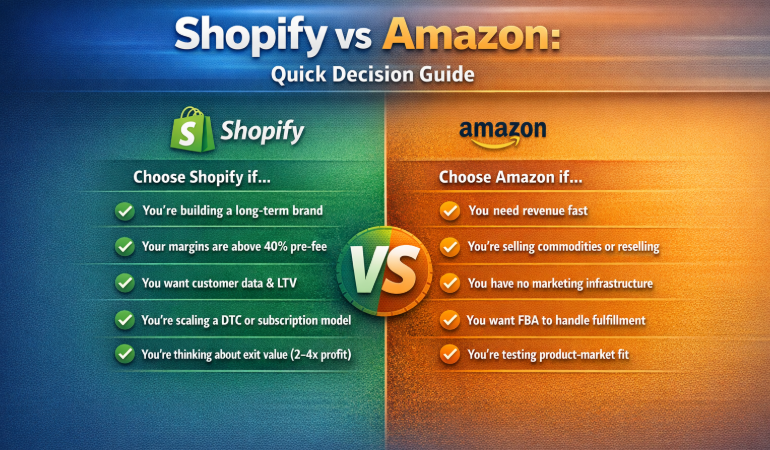
Choose Shopify or Amazon based on your business goals and margins
The smarter play in 2026: The hybrid strategy
The most profitable ecommerce brands in 2026 aren't debating Shopify vs Amazon. They're running both with purpose.
Automate Shopify accounting with seamless QuickBooks integration
Amazon handles customer acquisition and product discovery. Shopify runs brand, retention, and margin. Together, they cover the full customer journey. Separately, each one has a ceiling.
Simplify Amazon accounting with automated data sync to QuickBooks
The risk with the hybrid model isn't strategic, it's operational. Running two channels without synchronized inventory leads to overselling. Disconnected revenue data across platforms makes it impossible to know your true margin by channel. And when Amazon's payout deposits don't line up with your order data, you're making financial decisions on numbers you can't trust.
This is the operational gap that tools like Webgility are built to solve. Webgility connects Shopify and Amazon into one clean financial and inventory workflow. It syncs orders, fees, refunds, and payouts directly into QuickBooks with full context.
So instead of guessing which channel is actually profitable, you know. And that clarity is what separates brands that scale sustainably from those that scale into confusion.
FAQs
Is Shopify or Amazon more profitable?
Shopify gives you full control and higher profit per sale, while Amazon FBA offers faster sales and Prime shipping. Amazon FBA is easier for beginners who want quick sales, but Shopify is better for long-term brand building.
Which ecommerce is most profitable?
The hybrid model using Amazon for discovery and Shopify for retention tends to generate the best combined profitability. Amazon fills the top of the funnel; Shopify maximizes lifetime value. The key is having the operational infrastructure to run both without margin leakage.
What are the biggest costs on Amazon?
Referral fees, FBA fulfillment costs, storage fees, and advertising (PPC) are the biggest contributors, often totaling 25–40% of revenue.
Do you need ads on Shopify?
Yes, especially early on. However, unlike Amazon, Shopify allows you to reduce reliance on ads over time through repeat customers and retention strategies.
%20(1).jpg?width=56&height=56&name=IMG_9737%20(2)%20(1).jpg) Nikita Sikri
Nikita Sikri


.png?width=24&height=24&name=image%20(2).png) Monika Tripathi
Monika Tripathi


%20(1).jpg?width=24&height=24&name=IMG_9737%20(2)%20(1).jpg) Nikita Sikri
Nikita Sikri