
.png?width=32&height=32&name=image%20(9).png)
 May 8, 2026
 5 min read
Contents

|
TL;DR
|
For many ecommerce sellers, pricing decisions start with supplier costs and competitor research. But there’s a major problem with that approach: supplier cost is rarely the true cost of a product.
Shipping charges, duties, fulfillment fees, insurance, marketplace commissions, storage costs, and payment processing fees can dramatically change your actual profitability. That’s where understanding landed cost becomes critical.
Landed cost is the total cost of getting a product ready for sale, while the selling price is what customers pay for it. The gap between the two determines your real profit margin.
|
Here’s an example: You ordered 500 units at $10 each. You listed the product at $19.99 and told yourself you had nearly a 50% margin. But by the time that shipment reached your warehouse, the real cost was $14.80 per unit and your actual gross margin had quietly collapsed to 26%. |
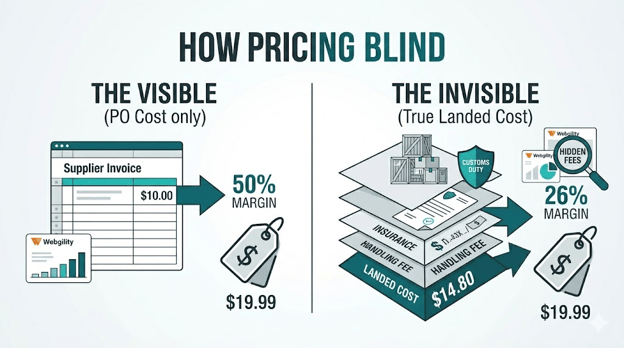
Visible costs vs true landed cost impact on profit margins.
And for most ecommerce sellers, this gap is invisible until it shows up as a month-end shortfall or an unprofitable promo.
This guide explains what landed cost actually is, how it differs from selling price, and how to use both numbers together to make pricing decisions that protect your margins, not just your revenue.
What is the landed cost?
Landed cost is the total expense involved in sourcing, transporting, and preparing a product for sale. It goes far beyond the supplier’s invoice price. For ecommerce businesses, landed cost often includes multiple operational and logistical expenses that directly impact profitability.
Common components of landed cost include:
- Product or manufacturing cost
- Freight and shipping charges
- Customs duties and tariffs
- Insurance fees
- Brokerage and import fees
- Warehouse handling costs
- Packaging expenses
- Fulfillment or 3PL costs
Landed cost formula:Landed Cost = Product Cost + Shipping + Duties + Taxes + Insurance + Handling Fees |
What is the selling price?
Selling price is the amount customers pay for a product. Unlike landed cost, which reflects operational expenses, selling price is market-facing. It’s influenced by factors such as:
- Competitor pricing
- Customer demand
- Brand positioning
- Marketplace dynamics
- Profit goals
The challenge for sellers is finding the right balance between competitiveness and profitability.
Selling price formula:Selling Price = Landed Cost + Desired Profit Margin |
💡Quick fact: If a product has a landed cost of $20 and the seller wants a 40% margin, the selling price must account for that target while still remaining competitive in the market. This is where many ecommerce businesses struggle. A product may appear profitable on paper until hidden costs reduce the actual margin.
Landed cost vs selling price: Quick comparison
Although the two terms are closely related, they serve very different purposes in ecommerce operations.
|
Landed Cost |
Selling Price |
|
Internal operational cost |
Customer-facing price |
|
Includes logistics and import fees |
Includes markup and profit margin |
|
Determines actual profitability |
Determines market competitiveness |
|
Changes with supply chain costs |
Changes with market demand |
If landed costs increase but selling prices remain unchanged, profitability declines. On the other hand, increasing prices too aggressively can reduce competitiveness and hurt sales volume.
The real gap: Why most sellers are pricing blind
The majority of ecommerce operators set prices based on their supplier invoice. That is the number that lives in their memory, their spreadsheets, and often their QuickBooks. But the supplier invoice is only one component of landed cost and typically the smallest one as a percentage of the total gap.
Here is what that looks like in practice:
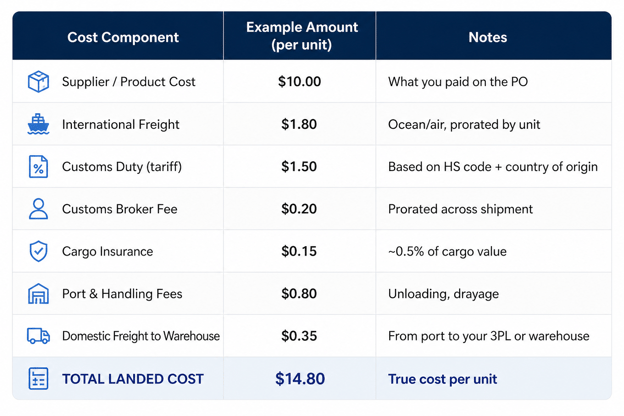
Example landed cost breakdown per unit.
A seller pricing at $19.99 against a $10 PO cost believes they have a 50% gross margin. Their actual landed cost is $14.80. Before platform fees, fulfillment, and returns, their true gross margin is already under 26%.
Layer in a 15% Amazon referral fee ($3.00), $3.50 in FBA fulfillment, and a 5% return rate and the math deteriorates further. A product that looks profitable becomes one that barely breaks even at full price and loses money the moment you run a promotion.
|
Quick fact: Your Shopify dashboard shows revenue. Your QuickBooks shows what you paid. Neither shows you what the product actually cost to land and that’s the number that determines whether your business is actually profitable. |
Suggested read: Gross vs. Net Revenue: Why Your $100K/Month Might Actually Be a Loss
From landed cost to selling price: Protecting your margin before you set a price
Once you have your true landed cost per unit, you can build a selling price that genuinely protects your margin. The formula accounts for every cost between your warehouse shelf and a completed sale.
|
Selling Price = Landed Cost ÷ (1 − Platform Fee % − Fulfillment Cost % − Return Buffer % − Target Net Margin %) |
From the example above, now we have a product with:
-
The landed cost $14.80
-
Targeting a 20% net margin
-
Selling on Amazon: 15% referral fee
-
With FBA fulfillment at 18% of price
-
Return buffer of 5%
✔ The floor selling price should be approximately $26 – $27.
✖ Not $19.99.
The difference between pricing at $19.99 and $26.99 on a high-velocity SKU is the difference between building a business and funding one that looks healthy until it suddenly isn't.
Why promotions break down when landed cost is unknown (Discount trap)
Promotions and discounting decisions are where an unknown landed cost does the most damage. When you do not know your true margin floor, you cannot know how much room you have to discount.
Running a 20% discount on a product with a 22% gross margin does not reduce your profit, it eliminates it. Running it on a product where you believe the margin is 40% but the actual landed cost makes it 24% produces the same result.
|
Reality check: Discounting without knowing your landed cost isn’t a promotion. It’s a margin leak and most sellers don’t find out until month-end. |
Remember, the sellers who grow profitably are not the ones running the most aggressive promotions; they’re the ones who understand their numbers well enough to know exactly what they can afford to discount, and on which SKUs.
How automation helps sellers track true landed costs
As ecommerce operations become more complex, manually tracking landed costs across channels, fulfillment providers, and accounting systems becomes difficult.
Without centralized reporting, it’s difficult to understand which products, channels, or customer segments are truly profitable.
This is where ecommerce accounting automation solutions like Webgility help ecommerce businesses connect operational and accounting data so teams can make more informed pricing and profitability decisions. With Webgility, you can:
- Sync ecommerce orders with accounting systems
- Track SKU-level profitability
- Reconcile sales, fees, and expenses automatically
- Improve inventory and financial visibility
- Reduce manual data entry errors
- Generate more accurate financial reports
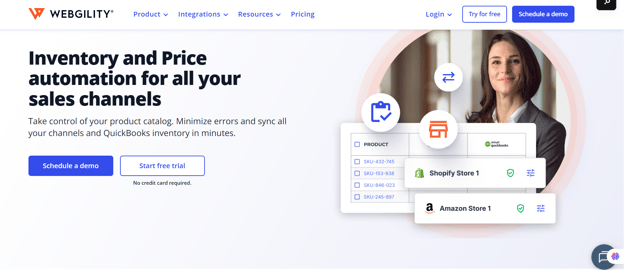
Webgility inventory and price automation for multichannel sellers.
For multichannel sellers, this visibility becomes especially valuable because costs vary across:
- Amazon
- Shopify
- Walmart
- eBay
- Wholesale channels
- 3PL providers
Instead of relying on disconnected spreadsheets, sellers gain clearer visibility into how landed costs affect overall business performance.
|
Note: This math only works if your COGS is accurate in your books, if you're posting summary-level data, you're pricing blind. |
Suggested read: How to Prevent Delays and Double Refunds
Stop guessing, start pricing on real numbers
If your QuickBooks only reflects what you paid your supplier, not what you paid to get the product to your shelf, that means your COGS is wrong, and so is every price built on top of it.
Webgility keeps landed cost, COGS, and margins aligned across every channel automatically so your pricing decisions are built on real numbers, not gut feel.
See how Webgility brings landed cost clarity to your books. Schedule a quick demo.
FAQs
What is included in the landed cost?
Landed cost typically includes supplier cost, shipping charges, customs duties, taxes, insurance, brokerage fees, handling expenses, and fulfillment costs associated with getting a product ready for sale.
How do you calculate selling price from landed cost?
Selling price is generally calculated by adding the desired profit margin to the total landed cost. For example, if a product’s landed cost is $25 and the target margin is 40%, the selling price must account for that margin while remaining competitive.
Why is the landed cost important in ecommerce?
Landed cost helps ecommerce businesses understand their true product profitability. Accurate landed cost tracking prevents underpricing, improves financial reporting, supports smarter pricing decisions, and helps sellers maintain healthy margins as operational costs change.
.png?width=56&height=56&name=image%20(9).png) Nikita Sikri
Nikita Sikri


.png?width=24&height=24&name=image%20(9).png) Nikita Sikri
Nikita Sikri


.png?width=24&height=24&name=image%20(1).png) Yash Bodane
Yash Bodane