.png?width=96&name=image%20(1).png)

|
Key Takeaways:
|
You closed $100,000 in sales this month. Congrats.
But your bank account shows $47,000.
Where did the rest go?
Welcome to ecommerce reality. Between checkout and cash hitting your bank account, there are payout cycles, processor delays, marketplace holds, referral fees, FBA charges, shipping labels, ad spend, refunds, chargebacks, and reserve adjustments. What you receive isn’t your sales total, it’s a bundled net settlement.
Amazon releases funds on a schedule. Shopify batches deposits. Marketplaces deduct fees before paying you. The deposit you see is not revenue, it’s what’s left.
Recording deposits as revenue distorts your numbers, hides true performance, and turns reconciliation into a headache.
This guide explains why the settlement gap exists, the three major problems it creates, and how order-level automation fixes it, with a real customer example.
What is the order-to-payout process and why does this gap exist in ecommerce?
The order-to-payout process tracks a transaction from the moment a customer places an order to the moment you receive the funds. In ecommerce, those two events rarely happen on the same day:
- Order date (Revenue event): The customer completes checkout. Revenue is earned
- Payout date (Cash event): The marketplace or payment processor releases funds to your bank
The time between these events is the order to payout gap. And in ecommerce, it’s structural, not accidental.
If you sell through Shopify, Amazon, Walmart, or eBay, payouts don’t move directly from payment processors / customers to sellers. They pass through platform rules, fee structures, reserve policies, and batching systems first.
Here’s why the gap exists:
1. Marketplace payout cycles
Marketplaces don't pay you instantly:
| Sales channel | Typical payout cycle | The settlement gap (Sale to Bank) | Factors that extend the gap |
| Amazon | Every 14 days | 14–21 days | Account Level Reserve (ALR), high return rates |
| Shopify | Daily or every 2-3 days | 3–5 business days | Weekends, bank holidays, high-risk flags |
| Walmart | Every 14 days | 15–20 Days | 90-day waiting period for new sellers |
| eBay | Daily or Weekly | 2–7 business days | Seller performance level, payment holds |
Many platforms also maintain rolling reserves to protect against returns, disputes, or chargebacks. That means part of today’s sale may not be fully clear for weeks.
| The result: Your revenue timeline and your payout timeline move at different speeds. |
Suggested Read: Marketplace Fees 2026: Amazon, eBay, Etsy, Walmart Charges Explained
2. Fee deducted before deposits
What hits your bank account is a net settlement, not gross sales.
Before releasing funds, marketplaces deduct:
-
Referral and payment processing fees
-
Fulfillment fees (FBA, shipping labels, storage)
-
Advertising charges pulled from account balance
-
Refunds and chargebacks
Example:
You sell a product for $100 on Amazon.
Before payout, Amazon deducts:
-
$15 referral fee
-
$6 FBA fee
-
$4 ad spend
Your deposit reflects $75, not $100.
Nothing is missing. But unless those fees are recorded at the order level, your books won’t clearly show what happened.
3. Adjustments, splits, and timing differences
Ecommerce settlements are rarely one-to-one with sales reports.
You may see:
-
Split payouts across multiple settlement batches
-
Refunds processed in a later payout cycle
-
Inventory reimbursements posted separately
-
Chargebacks reversed weeks after the original sale
This creates timing differences that complicate reconciliation.
| Note: One deposit can contain pieces of hundreds of transactions across different dates, which can make reconciliation more complex. |
The three critical problems order-to-payout process creates
When the order date and settlement date aren’t aligned in your accounting, the impact goes beyond bookkeeping. It affects how you measure performance, close your books, and manage cash.
Problem #1: Revenue recognition distortion
Under accrual accounting, revenue should be recognized when it’s earned at checkout, not when a payout hits your bank. Yet many ecommerce businesses record deposits as income or unintentionally mix cash and accrual methods.
That creates:
-
Overstated or understated monthly revenue
-
Unreliable profit and loss statements
-
Distorted gross margin reporting
-
Misaligned tax periods
-
Inconsistent growth trends
Example:
You generate $100,000 in December sales, but only receive $45,000 in settlements before month-end, much of it tied to late-November orders. If you book that $45,000 as December revenue, December appears weak, and November appears inflated. Your reporting no longer reflects actual sales activity.
| 👉 Are you recording deposits as revenue? 😬 If yes, you're not alone. |
At lower sales volumes, it might seem harmless. The numbers roughly line up, and month-end adjustments patch the difference.
| 📈 But here’s the reality: Once you’re processing hundreds of orders per day, deposit-based bookkeeping stops being a shortcut and starts becoming a distortion. |
The bigger the gap between sale date and payout date, the less your P&L reflects what actually happened. Over time, this erodes confidence in your financials.
Problem #2: Reconciliation complexity
Marketplace deposits are bundled settlements, not clean summaries of daily sales.
You open QuickBooks and see a Shopify deposit for $4,852.10. To reconcile it, you must trace it back across multiple reports to determine what it represents.
That single deposit could include:
-
52 individual orders totaling $5,400
-
Less $162 in payment processing fees
-
Less $210 in refunds
-
Less than $200 rolling reserve
-
Plus a small shipping adjustment
One payout can combine transactions from multiple dates, fee categories, and adjustment types.
Now multiply that across Amazon, Shopify, Walmart, and other channels, every payout cycle, every month. Reconciliation becomes reactive and time-consuming instead of systematic and controlled.
Suggested read: 5 Best Ecommerce Payment Reconciliation Software in 2026
Problem #3: Cash flow visibility gaps
Revenue may look strong, but payout timing tells a different story.
When settlement timing is unclear, you lose predictability around:
-
Inventory reorders
-
Supplier payments
-
Advertising budgets
-
Working capital planning
Example:
You have $50,000 in sales this week and $30,000 in supplier payments due. But only $12,000 has settled from prior cycles. Without clear visibility into upcoming payouts and reserved funds, you’re forced to delay purchases, negotiate terms, or seek short-term financing.
The issue isn’t a lack of sales, it’s lack of settlement clarity.
The scaling problem: Why it gets worse as you grow
Manual processes that worked at $500,000 in annual revenue break completely at $5 million and above.
| Thumb rule: As you scale, complexity multiplies (At lower volumes, you can reconcile payouts manually, post monthly journal entries, and patch discrepancies in spreadsheets. But as order volume increases, the order-to-payout settlement gap widens and so does the risk). |
Growth adds layers of complexity:
-
More SKUs with different margins and tax treatments
-
Multiple marketplaces with different payout cycles
-
Higher ad spend is deducted directly from platform balances
-
Increased returns, chargebacks, and reserve holds
-
Multi-channel sales across DTC and marketplaces
For example, at 20 orders per day, you might reconcile a payout in 30 minutes. At 500 orders per day across Amazon and Shopify, that same process can consume hours and still leave discrepancies.
The automation solution: Order-level sync
To fix the order-to-payout settlement gap, revenue and payout must be recorded separately inside your accounting system.
|
👉 What it means: Order-level sync means that every individual order should flow to your accounting system in real-time or near-real-time, instead of waiting for a bundled payout. Here's what happens automatically:
|
| 👉 How will it help: Creates alignment between operational activity and financial reporting. |
| 👉 What it requires: Moving beyond deposit-based bookkeeping to structured, order-level data. |
How Webgility closes the settlement gap
Webgility connects sales channels with accounting platforms like QuickBooks, Xero, and even ERP like NetSuite, structuring transactions at the order level rather than the deposit level.
1. Real-time revenue recognition
The scenario: You’re considering a $50,000 inventory purchase. Over the last 48 hours, you’ve generated $15,000 in sales but none of it has settled yet. Your bank balance only reflects prior cycles.
The solution: Webgility provides real-time sync of every individual order as it occurs. It moves the data from your storefront to your books instantly, categorizing the gross sale, sales tax, and shipping income before the marketplace even processes the payout.
The result: You gain a live view of your business’s health. You can make high-stakes purchasing decisions based on today’s actual sales volume rather than waiting for a bi-weekly settlement report from Amazon or Walmart to tell you how you're doing.
2. Separates revenue and cash (Clearing accounts)
The scenario: You generate $5,000 in sales on Monday. That revenue is earned, but the cash sits with the marketplace. If recorded directly to your bank account, your financials overstate available cash.
The solution: Webgility uses marketplace clearing accounts to track funds in transit and automatically creates deposit entries based on settlement reports, moving the net payout into your bank account.
The result: Your balance sheet reflects two critical numbers clearly:
- Cash available
- Cash owed by marketplaces
Bank reconciliation stays clean, and you avoid spending against unsettled funds.
3. Payout reconciliation without manual matching
The scenario: You receive a $12,450 Shopify payout covering 142 orders, multiple refunds, and a reserve hold. Manual reconciliation takes hours and often leaves unexplained variances.
The solution: Webgility identifies every order (all 142) within that payout ID, matches gross sales to the net deposit, and separates refunds, fees, and reserves automatically.
The result: Reconciliation happens in seconds. Clearing the accounts balance. Settlement reports align precisely with accounting records.
4. The cross-month chaos (Accrual mapping)
The scenario: A $2,000 sale occurs on December 30. The payout lands January 12. Without accrual mapping, either December revenue is understated, or January is overstated.
The solution: Webgility records revenue in December (when earned) while holding the balance in the Clearing account until January’s deposit offsets it.
The result: Monthly reporting reflects true performance. Financial statements align with accrual accounting standards, not payout timing.
Suggested read: SKU-level profitability: Why your best-selling product might be losing you money
-2.png?width=863&height=575&name=unnamed%20(6)-2.png)
How Webgility helped Bond Products streamline order-to-payout settlement
Bond Products, a small, family-owned business managing complex inventory across multiple marketplaces, struggled with manual order entry and critical order to payout settlement challenges.
The challenge:
As online sales grew, Bond Products relied on manual order entry into QuickBooks. This led to errors, time-consuming reconciliation, and inventory mismatches that slowed operations.
The solution:
After implementing Webgility:
-
Orders synced automatically into QuickBooks
-
Inventory and pricing stayed aligned across channels
-
Manual data entry was eliminated
-
Financial reporting became accurate and scalable
As order volume increased, their accounting system scaled with it without adding administrative overhead.
Stop guessing. Start operating with clarity.
Remember that $100,000 in sales with only $47,000 in your account? That gap isn't going away, but the chaos it creates can.
In the ecommerce world, the sale is not the settlement. And when the order-to-payout settlement gap isn’t structured correctly, financial reporting starts to drift.
The fix isn’t more spreadsheets. It’s a cleaner accounting workflow.
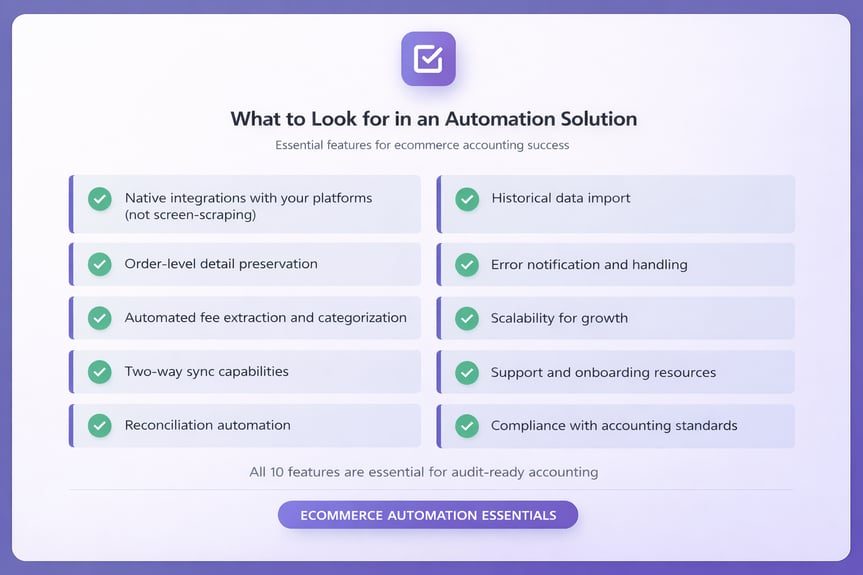
| This is your order-to-payout clarity checklist: ☐ Record revenue on the sale date, not the payout date ☐ Use clearing accounts to track funds in transit ☐ Categorize referral, fulfillment, ad, and processing fees at the order level ☐ Reconcile settlements against structured transactions, not lump-sum deposits ☐ Automate multi-channel sync to eliminate manual matching |
When revenue is separated from cash and synced at the order level, your books reflect actual performance. Month-end closes become predictable. Margins are visible by SKU and channel. Cash flow decisions are based on data, not delayed payouts.
Webgility is built to power that infrastructure. Stop guessing where the missing $53,000 went.
Start operating with financial clarity and confidence. Book a demo with Webgility today!
FAQs
What is the order-to-payout gap in ecommerce?
The order-to-payout gap is the time between a customer placing an order and the seller receiving the funds. It includes fulfillment, return windows, and payment processor settlement cycles. A longer gap hinders cash flow for sellers, making fast, automated reconciliation essential.
Why doesn’t my marketplace deposit match my sales report?
Marketplace deposits are net settlements. They typically include:
-
Gross sales
-
Minus referral and processing fees
-
Minus fulfillment charges
-
Minus refunds or chargebacks
-
Minus reserve holds
Because of these deductions and timing differences, your bank deposit rarely equals your total sales for a given period.
Should revenue be recorded on the sale date or payout date?
Under accrual accounting principles, revenue should be recorded when the sale occurs, not when the payout is received. Recording revenue based on deposits can distort monthly performance and margin reporting.
.png?width=128&name=image%20(1).png)