Monday morning.
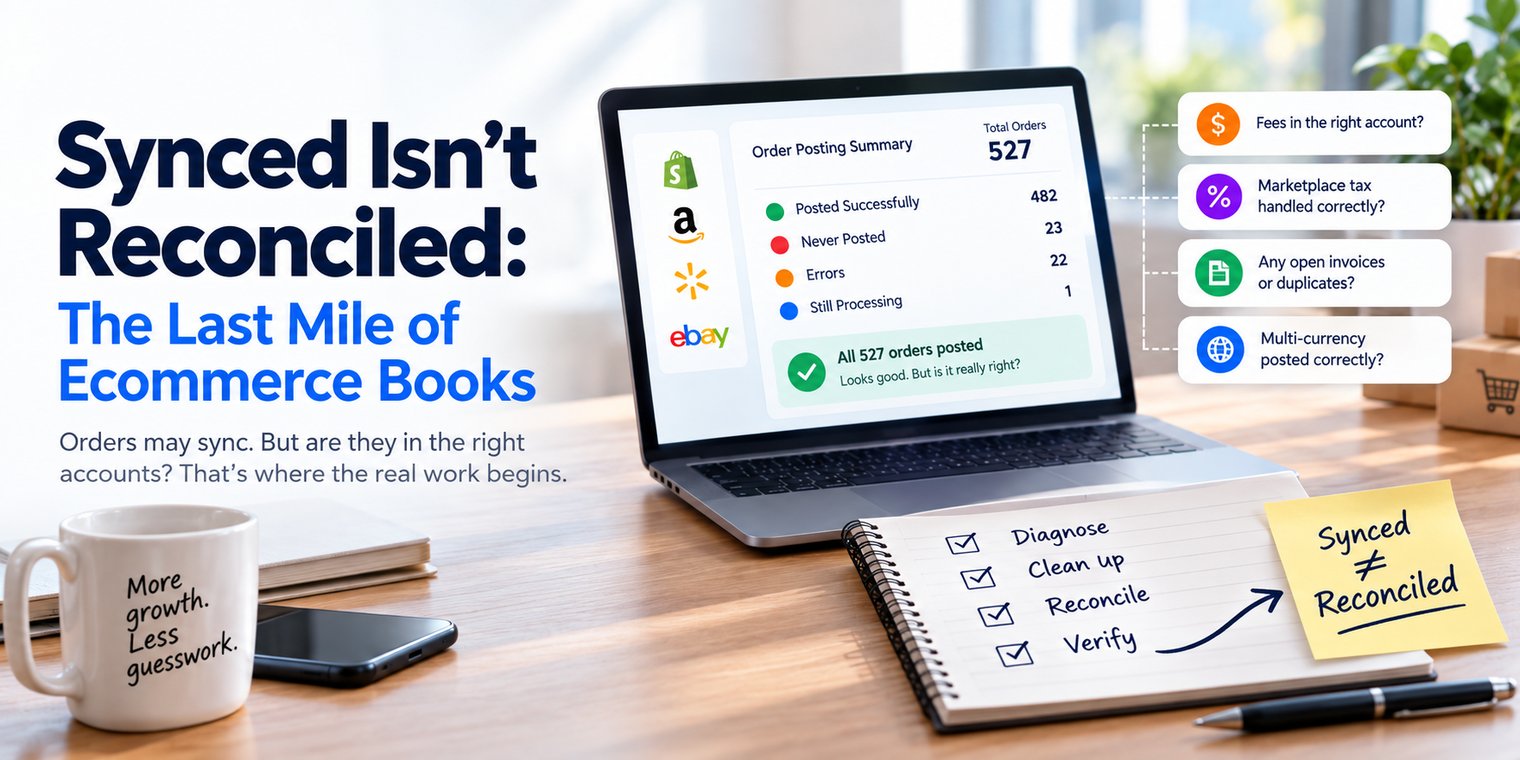
An ecommerce seller comes back after a busy weekend. 527 orders were supposed to make it into the books.
But only 482 posted successfully. Others were missing, errored, or still processing.
The finance team fixes the issues, and eventually all 527 orders show as posted.
Everything looks done.
Then reconciliation catches a problem: marketplace fees are hitting the wrong expense account.
No order is missing. No error remains. The automation worked.
The books are still wrong.
That’s the gap Webgility closes. Automation handles the flow and flags issues. When software can’t determine the right accounting outcome, a Webgility ecommerce accountant investigates, corrects, reconciles, and verifies the books.
If it’s automated, why are you still checking whether it worked?
Automation should remove work, not create another system someone has to supervise.
Suppose one of those 527 orders fails to post, so someone enters it manually. A few hours later, the connection recovers and posts the original transaction too.
The automation eventually “worked.”
The books now contain a duplicate.
That is why visibility comes first.
You need to know:
What worked. What didn’t. What is still in progress. And what needs attention.
But visibility only answers:
Did it work?
Reconciliation answers:
Did it land correctly?
And those are not the same thing.
Four places “synced” can still mean “wrong”
Books Done specifically identifies four areas where “synced” is not the same as “posted correctly.”

1. Fee and account posting
A transaction can post successfully and still hit the wrong account.
Example: All 527 orders make it into QuickBooks, but Amazon marketplace fees are mapped to the wrong expense account. Nothing technically fails, yet the P&L no longer shows the true cost of selling on Amazon.
2. Marketplace-collected sales tax
Marketplaces often collect and remit sales tax on the seller’s behalf.
Example: Tax attached to some of those 527 orders is collected and remitted by Amazon, but the books still record it as Sales Tax Payable. The orders posted correctly, but the balance sheet now shows a liability the business does not actually owe.
3. Open AR and duplicate payments
A transaction can settle while the original invoice remains open.
Example: One of the 527 orders is paid, but the invoice stays open in QuickBooks. The books now suggest the customer still owes money that has already been collected.
4. Multi-currency
Cross-border orders may post successfully but use the wrong currency treatment or account.
Example: A Shopify order among the 527 is recorded in euros, but its processing fee lands in a USD account without the right currency treatment. The transaction exists, yet reconciliation exposes the mismatch.
The pattern is the same:
Automation can confirm that the transaction moved. Accounting judgment determines whether it moved to the right place.
This is the last mile of ecommerce accounting
The first mile is getting ecommerce activity out of Shopify, Amazon, Walmart, and other channels.
Automation handles much of the middle: orders, refunds, fees, payouts, taxes, inventory activity, and accounting entries.
Then comes the final stretch between:
“All 527 orders were processed.”
and
“I trust what those 527 orders did to my books.”
That is the last mile.
From diagnosis to books done
Finding one wrong fee account is not enough.
You also need to know whether that issue points to something deeper.
Books Done follows a structured workflow:
Diagnosis → Cleanup → Month-End Close
The diagnosis identifies accounting gaps and risk areas. Cleanup resolves the findings. Then the same framework becomes part of the recurring month-end close.
The diagnosis covers 11 ecommerce-specific areas:
- Chart of Accounts
- SKU Hygiene
- GL Code Mapping
- Undeposited Funds
- Clearing Account
- Bank Feeds
- Bank Reconciliation
- AR Aging
- State Tax Threshold
- COGS & Ecommerce Fees
- Inventory GL
And these are not just onboarding checks. The same 11 areas are reviewed again during the recurring Month-End Close.
So next month, the problem may not be the same Amazon fee mapping.
It may be a new SKU, a clearing balance, an open invoice, a tax issue, or an inventory mismatch.
One successful month isn't enough
The seller does not need confidence only on the Monday after those 527 orders.
They need it every month.
That is why Books Done moves through three core deliverables:
Books Diagnosis Report → Books Cleanup Completion Report → Month-End Close Report.
And the recurring close adds order-level traceability, including fees broken down by order, refunds tied to their original orders, and Amazon FBA settlements separated into sales, fees, refunds, and reimbursements.
So when something does not add up, the accountant can trace it back to the transaction that created the difference rather than working backward from a channel-level total.
When automation stops, Webgility doesn't
You should not have to see 527 successful transactions and still wonder whether the numbers behind them are right.
Software should automate what it can. Visibility should surface what needs attention. And when the right accounting outcome requires judgment, someone should own getting the books across the finish line.
Automation where rules work.
Expert judgment where they don't.
Books you can trust. Decisions you can back.
Want ecommerce accounting that ends with reconciled books, not another exception queue? Talk to a Webgility ecommerce accounting expert.