Enter your email to watch


How to Purchase the Inventory You Need to Keep Selling
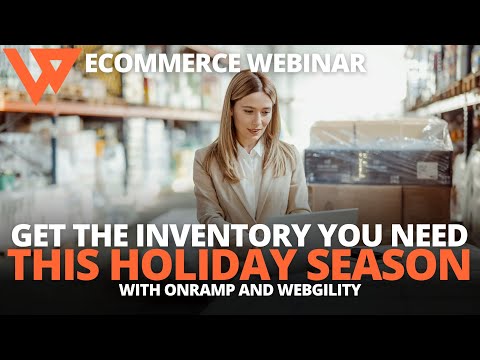
Running out of inventory can stall growth just when demand is highest. In this partner webinar, Webgility and Onramp Funds explain how ecommerce businesses can use working capital strategically to purchase inventory, improve cash flow, fund marketing, and scale sustainably without relying solely on traditional financing.
- What working capital means for ecommerce businesses.
- Understanding the ecommerce cash conversion cycle.
- How to calculate inventory funding needs.
- Different sources of ecommerce financing and their pros and cons.
- Why inventory is the biggest working capital expense.
- How working capital supports advertising and fulfillment.
- Common mistakes when borrowing for growth.
- How purpose-built ecommerce financing differs from traditional loans.
- Real customer case studies on scaling with working capital.
- How Webgility data helps merchants make better inventory purchasing decisions.
How to Purchase the Inventory You Need to Keep Selling
One of the biggest reasons ecommerce businesses stop growing isn't a lack of demand—it's running out of inventory. As sales increase, merchants often find themselves waiting for cash from previous orders before they can purchase their next batch of products. This creates a cash flow gap that limits growth.
In this partner webinar, Webgility and Onramp Funds explain how working capital helps ecommerce businesses bridge that gap and continue scaling. Rather than viewing financing as a last resort, the speakers encourage merchants to think of working capital as a tool that keeps inventory moving and sales growing.
Inventory is typically the largest expense in an ecommerce business. Without inventory, advertising becomes ineffective because customers cannot purchase products that are out of stock. Likewise, fulfillment and shipping depend on having inventory available in the first place. The webinar explains that inventory, marketing, and fulfillment form one continuous cash conversion cycle, making each stage dependent on the previous one.
The discussion also covers how merchants should estimate their funding needs. Instead of borrowing large sums far in advance, businesses should understand their inventory turnover cycle, supplier lead times, shipping timelines, and historical sales performance. Most ecommerce businesses operate on recurring inventory cycles, so financing should align with those cycles rather than fixed annual repayment schedules.
The webinar compares several funding options, including personal savings, business credit cards, traditional bank loans, merchant cash advances, and purpose-built ecommerce financing. Each option has advantages, but ecommerce-specific funding solutions are designed around actual sales performance and inventory turnover instead of generic lending models.
Several customer examples illustrate how merchants used working capital to grow sustainably. One business became profitable within six months after gaining access to funding that matched its sales cycle. Another gradually increased borrowing as revenue expanded, using financing to purchase inventory and invest in marketing without overextending the business. The speakers emphasize borrowing only what is needed, testing growth strategies carefully, and increasing investment as demand is proven.
Finally, the webinar highlights the role of financial visibility in making smarter purchasing decisions. Before deciding how much inventory to buy or how much capital to borrow, merchants need accurate reporting on sales, cash flow, inventory turnover, margins, and profitability. Webgility provides these insights by consolidating ecommerce and accounting data, helping businesses confidently determine when it's time to replenish inventory and invest in growth.
For ecommerce businesses preparing for busy selling seasons or planning their next stage of growth, understanding working capital and inventory planning can make the difference between missing demand and capturing every sales opportunity.
What is working capital in ecommerce?
Working capital is the cash needed to purchase inventory, pay for advertising, shipping, and fulfillment before sales deposits are received.
Why is inventory so important for ecommerce growth?
Inventory is the foundation of the ecommerce cash conversion cycle. Without inventory, businesses cannot fulfill orders or generate revenue from advertising campaigns.
How should merchants estimate inventory funding needs?
Businesses should evaluate inventory turnover, supplier lead times, shipping timelines, historical sales, and future growth plans before deciding how much working capital to use.
What are the common funding options for ecommerce businesses?
The webinar covers personal savings, business credit cards, traditional bank loans, merchant cash advances, and ecommerce-specific working capital solutions.
How does Webgility help with inventory purchasing decisions?
Webgility provides visibility into sales, inventory, cash flow, profitability, and financial performance so merchants can make informed purchasing and financing decisions.
Watch More






Find out what your operational gaps are actually costing you.
Our team of experts will help surface your operations and finance concerns. In 30 minutes, we will discuss your channels, accounting setup, leakages, inventory inconsistencies, and close process.