
Enter your details to watch

John May
Ecommerce Expert
What Your Books Are Telling You (That You're Not Hearing)
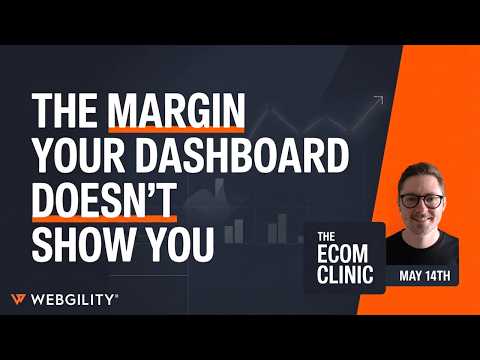
Many ecommerce businesses have books that reconcile perfectly while still making decisions based on misleading financial data. This webinar explains why syncing data isn't the same as understanding it, and how to uncover the hidden signals inside your books.
- Why syncing ecommerce data does not guarantee financial accuracy.
- How marketplace fee aggregation hides your true profitability.
- Why Amazon settlement timing can distort weekly and monthly financial reports.
- How inventory valuation and COGS errors create misleading margins.
- Four financial distortions every ecommerce business should review every month.
- How better financial visibility leads to better pricing, inventory, and growth decisions.
Ecommerce Financial Visibility: What Your Books Are Really Telling You
Many ecommerce businesses assume that if their books reconcile and their bank account balances, everything is financially accurate. Unfortunately, that's not always true.
This webinar introduces a simple but powerful idea: syncing isn't truth. Your orders may flow correctly into QuickBooks, your books may balance, and your reports may still hide the information you actually need to make profitable decisions.
The webinar begins by showing how a business reporting a 60% gross margin was actually operating closer to 34% after marketplace fees, settlement mechanics, and accounting classifications were properly considered. Those missing details directly influence pricing, inventory purchases, advertising budgets, and growth plans.
The first hidden issue is marketplace fee aggregation.
Many businesses record Amazon or marketplace fees as a single expense. While this keeps the books balanced, it hides referral fees, fulfillment costs, storage charges, advertising expenses, refunds, and other deductions that affect profitability. Without seeing each category separately, it's difficult to understand where money is actually going or identify opportunities to reduce costs.
The second issue is settlement timing.
Amazon settlements don't align neatly with calendar months. Revenue may be recognized in one period while cash arrives much later, creating misleading weekly or monthly financial reports. Looking only at deposits can make one week appear highly profitable while another looks weak, even though the underlying sales tell a different story.
The webinar also explores how incorrect cost classifications affect reported margins.
Recording marketplace deposits as revenue instead of gross sales understates revenue and hides costs inside expense accounts. The result is financial statements that appear healthy but don't explain why profitability changes over time.
Inventory creates another common blind spot.
Differences between QuickBooks inventory, marketplace inventory, returns, damaged goods, bundled products, and multichannel stock can significantly distort Cost of Goods Sold (COGS). Even relatively small inventory mismatches can materially change reported profits and lead to poor purchasing decisions.
The webinar summarizes these challenges as four recurring financial distortions:
- Settlement timing
- Marketplace fee aggregation
- Cost misclassification
- Inventory valuation gaps
Reviewing these four areas every month provides far greater Ecommerce Financial Visibility than simply confirming that your books reconcile.
Solutions like Ecommerce Accounting Automation, QuickBooks Ecommerce Accounting, Order-level Reconciliation, and QuickBooks Payout Reconciliation help organize marketplace data automatically. Instead of simply syncing transactions, they provide the detailed financial trail needed to understand margins, reconcile payouts, classify fees accurately, and make confident business decisions.
Ultimately, balanced books are only the starting point. Financial visibility comes from understanding the story behind every payout, fee, inventory movement, and accounting entry.
What is ecommerce financial visibility?
Ecommerce financial visibility is the ability to understand how revenue, fees, payouts, inventory, and expenses affect actual business profitability, rather than simply confirming that books reconcile.
Why can balanced books still be misleading?
Books can balance while hiding marketplace fees, settlement timing differences, inventory issues, or incorrect cost classifications that distort financial reports.
Why is Amazon settlement timing important?
Amazon payouts often cover sales from earlier periods, causing revenue and cash flow to appear in different reporting periods and making weekly or monthly performance harder to interpret.
How do marketplace fees affect profitability?
Referral fees, FBA fees, storage, advertising, refunds, and other charges all reduce margins. Tracking them separately provides a clearer understanding of profitability.
How does Webgility improve financial visibility?
Webgility automates order posting, payout reconciliation, fee categorization, inventory synchronization, and QuickBooks integration, helping businesses move beyond simple syncing to more accurate financial reporting.
Watch More








Find out what your operational gaps are actually costing you.
Our team of experts will help surface your operations and finance concerns. In 30 minutes, we will discuss your channels, accounting setup, leakages, inventory inconsistencies, and close process.