.png?width=96&name=image%20(3).png)

Key Takeaways:
- Choose a B2B ecommerce platform that fits your business size, sales model, and growth goals
- Prioritize features like customization, mobile optimization, secure payments, integrations, and scalability
- Compare platforms not just by pricing, but by ease of use, B2B functionality, and long-term flexibility
- Look for tools that support order management, inventory tracking, and multi-channel selling from one place
- Don’t stop at launching your store, protect profits by reducing reconciliation errors, hidden fees, and financial blind spots
Choosing the right B2B ecommerce platform is one of the most important decisions you'll make for your online store. With global ecommerce sales surpassing $6.4 trillion in 2025, and a projected CAGR of 6.84% through 2030, the opportunity has never been bigger. But so has the noise.
For B2B businesses, this growth presents a major opportunity to expand online, reach more customers, and simplify the buying experience. But with hundreds of ecommerce platforms available, from Shopify to BigCommerce and beyond, finding the right fit can feel overwhelming.
That’s why we’ve created this guide.
In this article, we’ll compare some of the best B2B ecommerce platforms based on their key features, pros and cons, and pricing. By the end, you’ll have a clearer understanding of which ecommerce solution best fits your business needs, sales model, and growth goals.
Best B2B ecommerce platforms
With numerous options available, it's essential to understand the unique features, pricing structures, and capabilities of each platform to make an informed decision. Let's dive into a comparison of some of the leading B2B ecommerce platforms-
1. Shopify
Shopify is one of the best B2B ecommerce platforms, known for its user-friendly interface and extensive app store, allowing businesses to customize their online stores easily.
Its built-in SEO tools and vast customization options make it ideal for all businesses to sell their products online and in person.
Suitable for: All business sizes
Features:
- Store Builder: Its user-friendly builder offers over 100 no-code, mobile-friendly themes
- Integration: Integrates with numerous well-known tools, including Zapier, Vitals, PageFly, eBay, Amazon, etc.
- Payment Gateway: Native payment provider compatible with over 100 third-party payment providers
Pros:
- Round-the-clock support through chat, email, and phone
- Editor with built-in AI assistant to optimize product listings
- Supports multiple currencies and languages, making it suitable for international sales
Cons:
- While templates are customizable, deeper customization may require coding knowledge
- Businesses may feel restricted by Shopify's rules and policies, including restrictions on product types, pricing structures, etc., limiting their control over their online presence
Pricing:
Shopify offers several pricing plans:
- Basic Shopify Plan: $29/month
- Shopify Plan: $79/month
- Advanced Shopify Plan: $299/month
- Shopify Retail Plan: $89/month (for synchronizing online and offline operations)
- Shopify Plus Plan: Starting at $2,300/month (for enterprise-level businesses)
- Enterprise Commerce Plan: Custom pricing for large enterprises.
Shopify has a G2 rating of 4.4/5. Here's a review from one of the happy customers:
|
Shopify is relatively easy to use. It is a quick solution to the issue of an e-commerce website without using tons of plugins (which frequently need to be updated) and provides a professional look for my business. |
Also read: Top 12 Ecommerce Automation Software To Drive Growth In 2025
2. BigCommerce
BigCommerce is an enterprise ecommerce solution that handles everything from web hosting to maintenance, so there's no need to worry about the technical aspects.
Whether you manage multiple brands or sell across different customer segments or regions, it enables you to streamline your operations from one single account.
Suitable for: Mid to large businesses
Features:
- Customer groups: Segment your customers for pricing, product access and promotions without having to maintain a second site
- Multi-currency: Accepts payments in over 100+ currencies and offers local payment methods through the gateway of your choice
- Integration: Integrates seamlessly with various platforms including NetSuite ERP, Salesforce, HubSpot, Clover, ZenDesk, etc.
Pros:
- Reliable round-the-clock support is available to assist with any issues or questions
- Built-in SEO tools improve visibility and attract organic traffic
- Multi-channel selling capabilities enable businesses to sell on diverse platforms like Amazon and eBay
Cons:
- While basic functions are user-friendly, some advanced features may require a steep learning curve
- The selection of free themes is relatively small, which may necessitate additional investment for premium designs
Pricing:
BigCommerce offers several pricing plans:
- Free Trial: 15 days
- Standard Plan: $29/month
- Plus Plan: $79/month
- Pro Plan: $299/month
- Enterprise Plan: Custom pricing based on individual business needs
BigCommerce has a G2 rating of 4.2/5. Here's a review from one of the happy customers:
|
It provides a lot of integration for ecommerce, and I am able to get support whenever I can. The implementation is as easy as clicking a few buttons and is super fast. |
3. Wix
Wix is one of many platforms intended to make ecommerce website building a fast and painless process. It offers unmatched website building features, a large library of stunning templates, and an easy-to-use editor. Wix also provides more than 900 professionally designed templates for a diverse range of industries and website needs, including online stores and blogs.
Suitable for: Small businesses
Features:
- Mobile optimization: Ecommerce website is automatically optimized for mobile devices, ensuring it looks great everywhere
- Automatic site backups: Creates backup points of your website that can be restored at any time
- Integration: Integrates seamlessly with platforms such as HubSpot, Mailchimp, Omnisend, etc
Pros:
- Allows you to add numerous third-party apps and add-ons to your site, such as an email marketing platform, live chat, appointment managers, etc
- Its drag-and-dop interface makes website creation easy without needing any coding knowledge
- Offer all-in-one solution for hosting, domain registration, and website building
Cons:
- Some users report slow loading times on complex sites
- Wix websites present certain incompatibilities with mobile devices
Pricing:
Here are the plans offered by Wix:
- Light: $17/month
- Core: $29/month
- Business: $36/month
- Business Elite: $159/month
Wix has a G2 rating of 4.2/5. Here's a review from one of the happy customers:
|
Wix is very user-friendly. You don't have to know a whole lot about building websites. They basically hold your hand through the process and make it easy for you to create a very nice-looking site. |
4. WooCommerce
WooCommerce is one of the best B2B ecommerce platforms that power more than 6 million stores. This free, open-source WordPress eCommerce plugin is very flexible and can be tailored to the needs of almost any business.
Suitable for: WordPress users and those seeking customization
Features:
- Built-in content manager: Create informative product descriptions and landing pages, showcasing the product's benefits that solve customer pain points
- Inventory Management: Keep track of stock levels and receive notifications when it's time to reorder
- Integration: Integrates well with platforms like HubSpot, FedEx, Mailchimp, Stripe, etc
Pros:
- Provide access to its core code, which offers complete control over the store's functionality and user experience
- Integrates with various payment gateways
- Maximize your visibility with its built-in SEO features, such as customizable product titles, product categories, etc
Cons:
- Limited to WordPress websites
- Demands significant web development experience, making it less suitable for those who aren't tech-savvy
Pricing:
WooCommerce is free but involves extra costs:
Estimated costs can range from $10/month for basic setups to over $70/month, depending on the plugins and themes used.
WooCommerce has a G2 rating of 4.4/5. Here's a review from one of the happy customers:
|
I frequently use this application for my online business because it provides everything I need to sell my digital products. I appreciate its flexibility, the wide range of plugins available, and the fact that it seamlessly integrates with WordPress. |
5. Adobe Commerce (Magento)
Adobe Commerce is an open-source ecommerce platform that can handle hundreds of thousands of products seamlessly.
This non-hosted ecommerce platform uses drag-and-drop page builder that offers extensive flexibility to design your website. It also eliminates the need for a developer to make changes to the online store.
Suitable for: Large businesses
Features:
- Optimized delivery for A/B testing: Test storefront content, layout, and component variations across pages and segments with easy-to-use A/B testing
- Company accounts: Let your customers set up accounts with multiple buyers that can be organized into buying groups or hierarchies
- Integration: Integrates with other Adobe products like Adobe Target, Adobe Experience Manager, Adobe Real-Time Customer Data Platform, and more
Pros:
- Comes with an extensive suite of SEO features such as image optimization, Google SEO roadmap generation, etc.
- Customers can interact with your brand on multiple channels, such as websites, mobile apps, social media, etc.
- Provides advanced inventory management and customer segmentation tools
Cons:
- High technical skills required
- The customization process is time-consuming
Pricing:
The pricing depends on business requirements.
Adobe Commerce has a G2 rating of 4.0/5. Here's a review from one of the happy customers:
|
I like the ability to go to market in different ways. You can use a monolith architecture or a compossible architecture with the same instance of Adobe Commerce. |
6. WizCommerce
WizCommerce is an AI-powered, B2B ecommerce platform built for wholesalers and
distributors. Designed to streamline operations, enhance customer experiences, and boost
sales, WizCommerce combines powerful AI-driven tools with seamless ERP integrations.
This scalable solution helps businesses create custom online stores, manage orders more
efficiently, and leverage AI insights to drive growth, enabling them to sell smarter and faster.
Suitable for: All business sizes
Features:
- Customer approval flow: Automate client onboarding with customized approval
steps for pricing, payment terms, and shipping options - Custom price lists: Offer tailored pricing and freight terms for each customer
segment to improve sales and satisfaction - Advanced product discovery: Use a typo-tolerant search bar, filters, and sorting
options to help customers quickly find products
Pros:
- Plugin-free architecture: No third-party plugins, ensuring better performance,
security, and smoother operations - Fully integrated b2b features: Essential B2B tools like bulk ordering and
advanced discovery are built directly into the platform - Seamless ERP integration: Syncs with your ERP system for real-time updates and
accurate data
Cons:
B2B Only: Tailored exclusively for B2B, so not suitable for B2C businesses
Pricing:
WizCommerce offers flexible pricing plans to meet the needs of different-sized businesses:
● Free Trial: 30 days
WizCommerce has a G2 rating of 4.8/5. Here's a review from one of the customers:
|
The ability to manage orders, inventory, quotes, and tear sheets, all in one place, has |
Key features to consider while choosing the best ecommerce platform
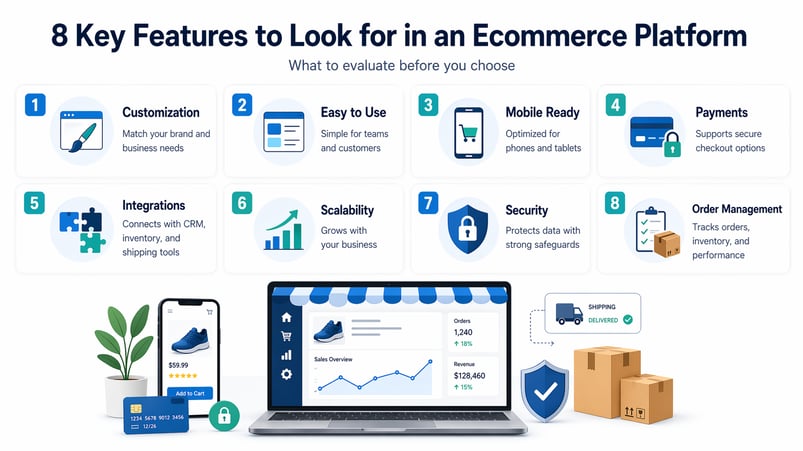
Here are some critical features that you should always consider when choosing an ecommerce platform for your business:
1. Customization
Choose a B2B ecommerce platform that aligns with your business goals and resources. It is ideal to opt for a platform that enables you to tailor the look and feel of your online store and match your brand identity.
2. User-friendly interface
Your ecommerce platform must be easy to navigate. It will not be only convenient to you but also to your customers and lead to higher conversion rates and less frustrated customers.
3. Mobile optimization
As mobile shopping surges, you must ensure your ecommerce platform can be optimized for mobile devices. The platform should provide responsive design capabilities, allowing your customers to shop conveniently from mobiles or tablets.
4. Payment processing
A good ecommerce platform supports multiple gateways, such as credit cards, PayPal, etc., and offers secure checkout options.
5. Integrations
Look for a platform that can integrate with third-party platforms like inventory management systems, CRMs, analytics tools, or shipping providers.
6. Scalability
The best ecommerce solution can always accommodate your business growth, whether it's expanding inventory or growing traffic by reaching new markets. The efficient platforms also offer features like multi-channel selling and support for international markets.
7. Security
The B2B ecommerce platform should provide SSL certification, PCI compliance and data encryption to protect your business and customer data.
8. Order management
Implementing an efficient order management system to your ecommerce business will enable you to manage orders, track inventory, and analyze performance. Thus, choosing a platform that syncs order details and prices across multiple sales channels will allow you to analyze performance from a central dashboard.
Final words
Choosing the right ecommerce platform is only half the battle, protecting your profits is the other half. Even the most well-run online stores can silently hemorrhage revenue through reconciliation errors, hidden fees, and financial blind spots.
That's where Webgility steps in. Businesses like BeeCure gained back 40 hours a month, time reinvested into growth, not manual data entry.
Better yet, Webgility's free Profit Leak Detector helps you pinpoint exactly where revenue is slipping through the cracks before it's too late.
Ready to stop the leaks and scale smarter? Book a demo today!
FAQs
What are the features of B2B ecommerce platforms?
B2B ecommerce solutions offer a range of features tailored for business-to-business transactions, including bulk ordering, order and inventory management, integration with ERP systems and personalized pricing.
Which ecommerce platform is best for B2B?
The best five B2B ecommerce platforms are Shopify, Wix, Woocommerce, BigCommerce, and Magento.
How do I know if my ecommerce platform is mobile-friendly?
Choosing an ecommerce platform that offers built-in responsive themes and design templates will ensure a smooth shopping experience.
.png?width=128&name=image%20(3).png)