.png?width=96&name=image%20(9).png)

|
TL;DR
|
You check the dashboard Monday morning. Revenue is up. Orders look healthy. You move on.
Six weeks later your bookkeeper calls. There is a $9,000 gap on the Amazon channel. Fees that were never posted. A payout reserve that did not clear. Refunds that hit the books when the return was requested, not when the cash came back.
The dashboard was not lying. It just was not built to tell you whether the numbers behind it are correct.
At $1M to $20M in ecommerce revenue, weekly decisions, such as channel investment, inventory reorders, discount depth, cash deployment depend on numbers that are reconciled, not just synced.
In this blog, we’ll uncover the seven metrics that drive those decisions, and why most operators are tracking them from the wrong source.
Why weekly monitoring matters more than monthly reporting
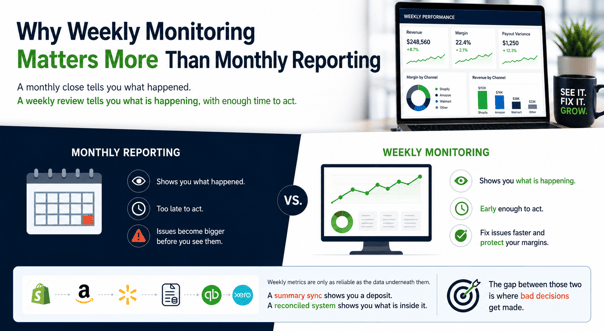
A monthly close tells you what happened. A weekly metric review tells you what is happening, with enough time to act.
- For founders, weekly visibility helps identify margin erosion before it becomes a quarterly surprise.
- For finance teams, it improves forecasting by using reconciled financial data rather than estimated channel performance.
- For ecommerce accountants and bookkeepers, continuous review reduces month-end cleanup and shortens close cycles.
The faster issues become visible, the faster they can be corrected.
Here’s the catch: Weekly metrics are only as reliable as the data underneath them. Most multi-channel operators already have a connector moving data from Shopify, Amazon, or Walmart into QuickBooks or Xero. The problem is that most connectors move summary data, not reconciled, transaction-level data.
A summary sync shows you a deposit. A reconciled system shows you what is inside it: the orders, the fees, the refunds, the reserves. The gap between those two is where bad decisions get made.
Suggested read: How to Maximize Amazon Profit: The Complete Seller's Audit Guide
6 ecommerce metrics every $1M-$20M brand should review weekly
|
Metric |
Why It Matters |
|
Net Revenue by Channel |
Shows actual revenue after fees and adjustments |
|
Payout Reconciliation Variance |
Identifies missing fees, reserves, and discrepancies |
|
Fee Trends |
Detects rising operating costs |
|
Inventory Position |
Prevents stockouts and over-ordering |
|
Refund Rate & Resolution |
Protects cash flow and reporting accuracy |
|
Adjusted Cash Position |
Improves purchasing and growth decisions |
Here we will discuss all these metrics that actually drive weekly decisions in detail:
1. Net settled revenue by channel
Gross revenue reported in Shopify or Amazon is pre-fee, pre-refund, pre-reserve. It is not what reaches the bank.
The metric to track: Net settled revenue by channel, reconciled against actual deposits.
If your storefront revenue and your QuickBooks balance do not match, you are looking at unreconciled data. Decisions built on that number are built on an estimate.
2. Payout reconciliation variance
An Amazon settlement statement is not a revenue confirmation. It is a net figure after fees, reserves, refund adjustments, and any balance Amazon decided to hold. The deposit in your bank is the result of a calculation you did not see.
The metric to track: Payout-to-orders reconciliation variance, by channel. The question is not whether the deposit arrived. The question is whether it matches what it should have been, at the order level, after all fee categories are accounted for.
Let’s suppose an unresolved gap compound. A $400 discrepancy this week will be a $5,000 discrepancy in six months that nobody can explain, surfacing as a margin problem on a P&L that is already closed.
|
Note: If you can’t explain what is inside this week's Amazon deposit without going to the channel portal, the reconciliation is not done. |
3. Fee trends by category, week-over-week
FBA storage fees, referral fees, fulfillment fees, and shipping adjustments are not stable. They shift by quarter, by season, by SKU. A brand reviewing fees monthly is always working from last month's cost structure, after the decisions that depended on those costs have already been made.
The metric worth tracking: Fee spend by category (storage, fulfillment, referral, advertising), week-over-week. Specifically, which categories are growing faster than revenue.
If storage fees are up 18% week-over-week, there is an inventory decision to make now. Monthly review surfaces that insight after it has already cost money.
The reason most operators don't have this level of visibility is that fee details typically don't flow into QuickBooks automatically unless the integration posts transactions at the line-item level. Unfortunately, many connectors only sync summary deposits, leaving the underlying fee categories trapped in the sales channel rather than reflected in the accounting system.
4. True inventory position across channels
Shopify shows 240 units. Amazon FBA shows 107. Your warehouse shows 190. Which is correct?
The answer may be none of them.
The metric that matters: a reconciled inventory position across all locations, adjusted for pending returns and in-transit inventory, tied to the unit values in QuickBooks.
Purchasing decisions made from a single channel's inventory count are cash decisions made on incomplete data. At $1M to $20M, those miscalculations compound quickly.
5. Refund rate and accounting resolution status
A refund is three things at once: a customer event, a cash flow event, and if it does not post correctly, an accounting error.
Most operators track refund rate as a customer service metric. The accounting consequence of that same refund, whether it was posted correctly, whether the return was received and credited, whether the channel actually reversed the fee, gets handled at month-end, if it gets handled at all.
The metric to track: Refund rate by channel, and refunds initiated versus refunds resolved in QuickBooks or Xero.
Example: At a 3% refund rate on $100K weekly revenue, there are $3,000 in weekly transactions that need to post correctly. If 20% carry resolution gaps, that is $600 per week in accounting distortion. Over a quarter, the margin report becomes a document nobody can stand behind.
The gap most connectors leave: Refunds post when initiated, not when cash is returned. The gap between those two is a liability that exists in the books but not in the bank.
6. Adjusted cash position after settlement timing
Cash in the bank is not always available. Marketplace reserves, delayed settlements, and pending payouts all affect liquidity.
Amazon, for example, may hold reserves while operating on multi-day payout cycles. As a result, a bank balance can overstate available cash.
The metric to track: Adjusted cash position net of all reserves and pending settlements, reconciled to the settlement data in QuickBooks or Xero. This provides a more realistic picture of working capital.
It's also one of the most important inputs when deciding:
- Whether to place a new inventory order
- Whether to increase ad spend
- Whether to delay major expenses
Growing brands often run into cash constraints not because they lack revenue, but because they misunderstand settlement timing.
Suggested read: 5 Decisions Every Multichannel Seller Gets Wrong for the Same Reason
Healthy weekly ranges for growing ecommerce brands
|
Metric |
Benchmark |
|
Return/Refund Rate |
24.5% average retail return rate (ecommerce 2025 in USA) |
|
Gross Margin |
50%–55% average gross margin across ecommerce; however, it varies a lot by industry |
|
Inventory Turnover |
4–6x/year (target range); 8x+ (high performers); 10.19x (industry average, Q4 2024); by category: electronics 4–6x, apparel 6–12x |
|
Reconciliation Variance |
Ideally 0%: any non-zero variance represents unreconciled transactions that compound month over month |
|
Marketplace Fees (Amazon FBA, total) |
30%–45% of revenue when referral fees (8%–15%), FBA fulfillment, storage, advertising, and inbound fees are included. |
Why weekly reporting breaks without reconciliation
Most multi-channel ecommerce brands already have a connector moving data from Shopify, Amazon, Walmart, and other sales channels into QuickBooks or Xero. The problem is that although they track the right metrics but from the wrong source as many connectors move summary data, not reconciled, transaction-level data.
As a result, weekly reports can look complete while being built on numbers that haven't actually been verified. Deposits don't always explain the marketplace fees, refunds, reserves, and adjustments behind them, making it difficult to trust the metrics you're reviewing.
With tools like Webgility, you get continuous reconciliation running against QuickBooks or Xero. Moreover, you can ensure:
- Every order is recorded individually with full line-item detail
- Every fee is classified to the correct account
- Every payout is matched back to the orders that created it
- Refunds post when cash moves, not when the request is submitted
- Inventory stays aligned across channels
- Weekly reports are built on verified numbers, not summary deposits

Webgility helps ecommerce brands keep books always on and reconciled.
The operational test
Pull this week's Amazon payout. Can you explain every dollar in that deposit at the order level, with fees broken by category, without going to the channel portal?
If the answer is no, the seven metrics above are being tracked from summary data. The decisions built on them carry a margin of error that compounds each week it goes unaddressed.
Software that reconciles continuously. Specialists who certify the close.
FAQs
What ecommerce metrics should I track weekly?
The most important weekly ecommerce metrics include net revenue by channel, channel margin, payout reconciliation variance, fee trends, inventory position, refund rates, and adjusted cash position.
Why is gross revenue not enough?
Gross revenue does not account for marketplace fees, reserves, refunds, chargebacks, or fulfillment costs, making it an incomplete measure of financial performance.
How often should ecommerce businesses reconcile payouts?
Fast-growing ecommerce brands should reconcile payouts continuously or at least weekly to identify discrepancies before month-end.
.png?width=128&name=image%20(9).png)