
.png?width=32&height=32&name=image%20(1).png)
 June 30, 2026
 5 min read
Contents


Quick answerIncrease Amazon advertising spend only if you can answer five questions with confidence:
If you can't answer those questions from your current reports, you may be scaling revenue without understanding profitability. |
Every Amazon seller wants the same answer at the start of a new quarter: should we increase ad spend?
On paper, the decision looks simple.
- Revenue is growing.
- ROAS looks healthy.
- The growth team wants a larger budget.
But revenue growth and profitable growth are not the same thing.
Many Amazon brands make scaling decisions using revenue reports, settlement deposits, and blended fee numbers. The problem is that none of those tell you what you actually earned after FBA fees, advertising costs, storage charges, returns, and reserve holds.
Before increasing spend, you need to know whether each additional Amazon sale creates more profit or simply more complexity and cash-flow pressure.
In this blog, we’ll help you determine whether your Amazon business is truly ready to scale. Let’s get started!
Is the number you're scaling from actually true?
Every Amazon brand doing $1M to $5M on Amazon with QuickBooks on the back end faces the same question at the beginning of a quarter.
Should we spend more to grow faster?
But the better question is: Are we sure the growth we’re building is actually profitable?
A campaign can hit its ROAS target. Revenue can increase. Sales can look healthy. But if you’re flying blind – Amazon fees, advertising costs, storage charges, returns, and reserves are not fully accounted for, your channel P&L can still tell the wrong story.
That does not mean the campaign failed. It means the numbers used to justify the campaign were incomplete.
Before increasing Amazon spend, you need to answer five questions that reveal whether your data is strong enough to support the decision.
Suggested read: Guide to FBA Spending
5 questions every Amazon operator should answer before scaling
These questions come directly from the operational blind spots most ecommerce businesses miss:
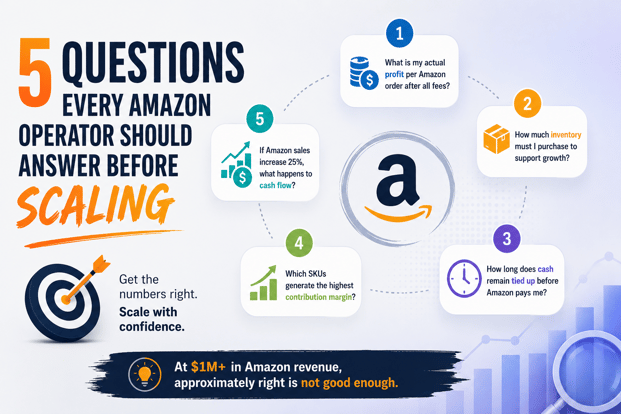
Five questions every Amazon seller should answer before increasing ad spend.
1. What is my actual profit per Amazon order after all fees?
Most sellers know gross revenue. Few know net profitability per order after FBA fulfillment fees, referral fees, storage, advertising, and return costs are all pulled out and correctly classified in QuickBooks.
If profitability is calculated using net settlement deposits rather than fully reconciled, order-level data, the number is an estimate.
“Estimates are dangerous when you're making six-figure advertising decisions”
2. How much inventory must I purchase to support projected growth?
Every additional dollar of Amazon revenue requires inventory investment ahead of the revenue arriving.
Without that calculation in hand before the scaling decision, brands run into the same set of problems: stockouts during peak periods, emergency replenishment orders at higher cost, lost Buy Box position, and expedited shipping that destroys the margin the campaign was supposed to generate.
Growth creates operational demands long before cash arrives.
3. How long does cash remain tied up before Amazon pays me?
Revenue timing matters just as much as revenue volume. Many operators look at sales growth without considering the gap between:
- Purchasing and selling inventory
- Amazon holding the reserve and releasing settlement funds
The longer that cycle becomes, the more working capital is required to support growth.
For many Amazon businesses, cash can be tied up for weeks or even months between inventory purchases, sales activity, reserve holds, and payout cycles.
A 25% revenue increase that requires inventory investment before the first settlement arrives is a working capital problem. The growth model has to include the timing, not just the revenue.
4. Which SKUs generate the highest contribution margin?
Not every product deserves more advertising.
Two SKUs at identical revenue can produce dramatically different cash outcomes once FBA fees, storage, and advertising are classified at the order level. The one with higher volume is not automatically the one worth scaling.
The goal isn't simply to drive more sales. The goal is to drive more profitable sales.
5. How will increased Amazon sales affect available cash flow?
This question brings the scaling decision back to reality. More Amazon sales can also mean more inventory purchases, higher fees, larger ad spend, delayed settlements, and cash held in reserve before money reaches your bank account.
That is why cash-flow visibility matters. You need to see how orders, fees, inventory, and settlements move together so you know whether growth will create more available cash flow or simply put more pressure on working capital.
At $1M+ in Amazon revenue, scaling from an approximate cash position is risky. The decision should be based on clear, connected financial data, not assumptions.
|
Thought: Scaling decisions don't start and end with five questions. If you want to know what else your books should be telling you, here are 100 questions every ecommerce operator should be asking. |
Why your Amazon dashboard doesn't tell you what you kept
Amazon tells you revenue. It doesn't tell you what you kept.
Four structural gaps sit between your Amazon dashboard and your actual margin:
1. FBA fees are hidden inside settlements
Referral fees, fulfillment fees, storage charges, and other costs are deducted before Amazon pays you. Many accounting systems only record the net deposit, making it difficult to see where margins are shrinking.
2. Settlement lag against order date
Orders happen today. Amazon pays later. When revenue and cash are viewed in the same period, profitability and cash flow can appear stronger than they really are.
3. Reserve hold not recorded
Amazon holds a percentage of your balance against potential returns. Most QuickBooks setups don't record this as a receivable. The result is an overstated cash position, and the overstatement compounds quietly until a reconciliation surfaces it.
4. Advertising cost buried in the settlement deduction
PPC charges appear as a line-item deduction inside the settlement, not as a separate advertising expense. Ad spend becomes invisible inside a blended fee number. The P&L closes.
The result? Incomplete profitability reporting.
Example: On $500,000 in quarterly Amazon sales, a 12% increase in FBA-related costs that's hidden inside a blended "Amazon fees" account can misstate profitability by roughly $60,000. The reports still look correct. The margin calculation isn't.
Suggested read: 7 Amazon Sales Data Analysis Mistakes Eroding Your Profit and How to Fix Them
What reconciled Amazon data looks like
Most Amazon sellers are working from sync-level data: net deposits posted to QuickBooks, fees blended, reserves untracked, ad spend buried. The books close. The numbers are approximate.
Reconciled Amazon data looks different:
|
What Most Sellers Have |
What Reconciled Data Looks Like |
|
Net deposit per settlement period |
Every order posted individually with fees broken out |
|
FBA fees as a single blended line |
Referral, fulfillment, storage, advertising in separate accounts |
|
Reserve not tracked |
Reserve balance recorded as a receivable in QuickBooks |
|
Ad spend inside the settlement deduction |
PPC in a dedicated advertising expense account |
The operator with this data answers the scaling question in 10 minutes, from existing reports. The one without it has to build the answer from scratch, or scale from a number that isn't what they think it is.
Getting here isn't a manual process, it's an infrastructure decision.
The reconciliation work that produces this data, matching every settlement line to the orders behind it, breaking out each fee type, tracking reserves as real receivables, separating ad spend from the blended deduction, happens at the accounting layer, not in a spreadsheet. Sellers who have it in place didn't build it themselves. They set up their accounting infra to do it continuously, so they have the numbers they can trust.
That's what Webgility does for Amazon sellers: every order, fee, and settlement reconciles into QuickBooks/Xero automatically, so the margin number your team is scaling from is built on orders and classified costs, not on deposits and estimates.
Amazon settlements don't show true profitability; fees, reserves, and adjustments matter.
|
Success story: You can't run a growing business without knowing what your operation data gaps are actually costing you. Webgility takes care of that. |
If you want to see what your Amazon numbers actually look like, your setup should break out FBA fees, referral fees, storage, advertising, reserves, and order-level data. This will provide you with deeper visibility into margins, cash flow, and growth opportunities.
Our ecommerce experts will guide you through→
FAQs
How do Amazon sellers calculate true profitability?
True profitability includes revenue minus referral fees, FBA fees, advertising costs, storage fees, returns, shipping costs, and product costs. Looking only at Amazon deposits or revenue can create an incomplete view of margins.
Why don't Amazon settlements match sales revenue?
Amazon deducts fees, advertising charges, reserve balances, refunds, and other adjustments before releasing settlement payments. As a result, deposits rarely match reported sales.
Should I increase Amazon advertising if ROAS is improving?
Not necessarily. A strong ROAS can still produce poor profitability if fulfillment fees, advertising costs, and inventory expenses are not accounted for at the order level.
.png?width=56&height=56&name=image%20(1).png) Yash Bodane
Yash Bodane


 Parag Mamnani, Webgility CEO

.png?width=24&height=24&name=image%20(1).png) Yash Bodane
Yash Bodane

.png?width=24&height=24&name=image%20(2).png) Monika Tripathi
Monika Tripathi