.png?width=96&name=image%20(1).png)
|
Key Takeaways:
|
Not long ago, buying something online meant opening six tabs, comparing prices across sites, and maybe abandoning the cart anyway. That experience is becoming a thing of the past.
Today's shoppers are asking AI assistants what to buy, getting a curated answer in seconds, and purchasing without ever visiting a brand's website. Zero-click interactions jumped from 26% of searches in 2022 to 77% on mobile in 2026 (Source). AI-driven retail traffic surged 4,700% year over year in July 2025 alone (Source).
The zero-click buyer is already here, and if you sell on Shopify or Amazon, this affects you now.
In this blog, we'll break down what's driving this shift, what sellers are silently losing, and exactly what to do about it.
What is a zero-click buyer?
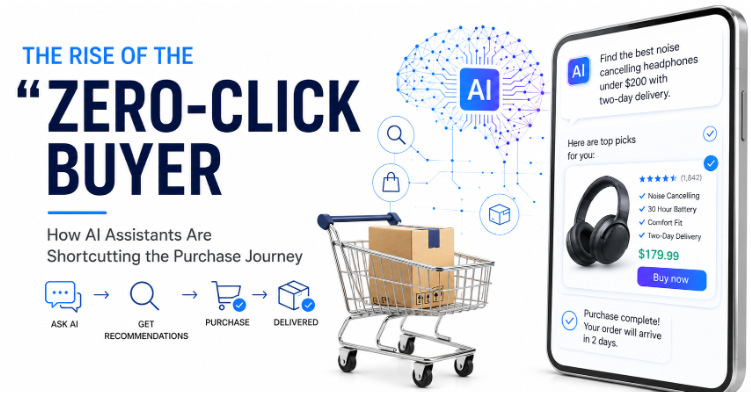
A zero-click buyer is a shopper who completes most of the purchase journey without traditional website browsing. They don't search Google, click through to product pages, or spend time comparing options manually. Instead, they hand the entire research process to an AI assistant.
It sounds like this:
"Find me the best running shoes under $150 for someone who runs on pavement." "Reorder my usual skincare products." "Compare these two espresso machines and tell me which one is worth the extra $40." "Buy the cheapest option with two-day delivery."
The AI handles the rest, discovery, comparison, recommendation, and in many cases, the transaction itself.
This buyer still exists. They still want your product. But the path they take to find it has completely changed.
What can an AI shopping assistant actually do?
Today's AI shopping assistants are autonomous agents capable of handling large portions of the purchase journey on their own.
Here's what they can do right now:
1. Understand complex, natural language queries. Forget keyword engineering. A shopper can type "cozy birthday gift for a mom who loves gardening, budget around $50, needs to ship by Friday" and get a curated, relevant shortlist, better than anything a keyword search would return.2. Compare products across the web. Tools like ChatGPT and Perplexity pull reviews, specs, and pricing from across multiple retailers and synthesize them into a clear recommendation with trade-offs explained. The shopper doesn't need to open a single product page.
3. Set auto-buy triggers. Amazon Rufus now lets shoppers define a price threshold for a product and purchase automatically the moment it hits that price. The buyer decides once and walks away. Rufus does the rest.
4. Complete checkout without leaving the chat. Perplexity's Instant Buy feature (powered by PayPal) and ChatGPT's Instant Checkout for supported Shopify merchants allow a purchase to be completed entirely within the conversation. No redirect. No checkout flow. Just a confirmation.
5. Reorder on autopilot. Amazon's Alexa+ monitors household consumption patterns and automatically restocks items when supplies run low. For repeat-purchase categories, cleaning supplies, pet food, skincare, this is already mainstream behavior.
6. Personalize over time. ChatGPT with memory enabled learns a user's preferences, past purchases, budget constraints, and even brand dislikes with every interaction. The more a shopper uses it, the sharper and more personalized the recommendations become.
How buyer behavior is changing, and why it's accelerating
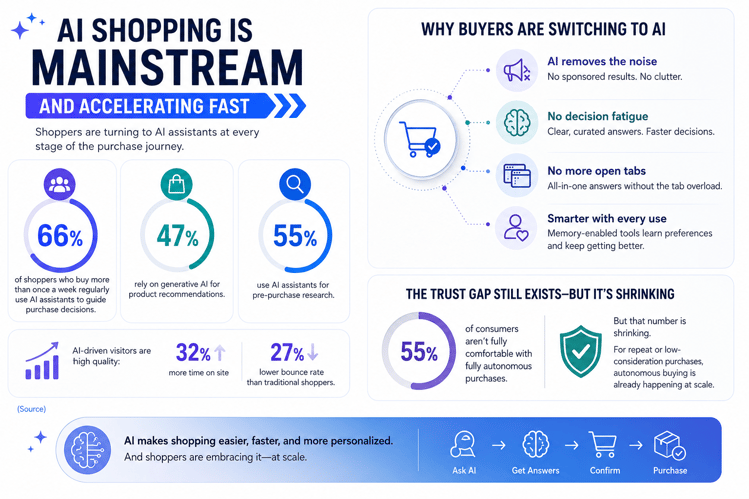
Why shoppers are switching to AI-assisted buying.
This isn't early adoption. It's a mainstream shift moving at an unusual pace.
66% of shoppers who buy more than once a week now regularly use AI assistants to guide purchase decisions. 47% rely on generative AI for product recommendations; 55% use it for pre-purchase research. And AI-driven visitors are high quality, they spend 32% more time on site and have a 27% lower bounce rate than traditional shoppers (Source).
Buyers are switching because AI removes the noise: no sponsored results, no decision fatigue, no 12 open tabs. Describing a need in plain language is simply easier than constructing the perfect search query. And tools with memory get smarter with every use, creating a flywheel that keeps buyers coming back to AI instead of Google.
The trust gap still exists, 55% of consumers aren't fully comfortable with fully autonomous purchases. But that number is shrinking, and for repeat or low-consideration purchases, autonomous buying is already happening at scale.
Why this changes ecommerce marketing
Compare the two journeys:
Traditional: Search → click ad → visit site → browse → compare → add to cart → checkout
AI-assisted: Ask AI → receive curated answer → confirm → purchase
Every step in the middle- where your homepage, paid ads, product photography, upsells, and retargeting pixels live, has been removed. The shopper may never see your website. The AI read your listing, summarized what mattered, and made a call.
The new question isn't "how do I get someone to click my ad?" It's "how do I get an AI to recommend my product?"
What sellers are losing and don't even know it
Getting recommended by AI is a win, but if you look closer, the sale comes with some invisible trade-offs most sellers haven't noticed yet.
The opportunities
- Higher-intent shoppers
- Faster conversions
- Better discovery for niche products
- More personalized shopping experiences
The risks
- Less control over brand storytelling
- More dependence on third-party AI platforms
- Reduced website traffic
- Greater pressure on operational accuracy
And that last point matters the most.
Because even if the customer journey changes, the operational side of ecommerce still has to work flawlessly.
Where Webgility fits
AI may shorten the front-end buying journey, but it increases pressure on the backend.
Every AI-assisted order still creates operational complexity:
- Orders must sync correctly
- Inventory must update in real time
- Fees must reconcile accurately
- Sales tax must map properly
- Marketplace payouts must balance
- SKU-level accounting must stay clean
As order volume grows, manual workflows become harder to manage.
That’s where Webgility helps.
Webgility automates ecommerce accounting and operations by connecting platforms like:
- Shopify
- Amazon
- Walmart
- eBay
- QuickBooks
- Xero
Instead of manually reconciling orders, fees, inventory, and payouts, sellers can keep everything synced automatically.
So when AI sends a buyer your way, your operations are ready to fulfill that promise, cleanly, accurately, and at scale. Webgility helps ecommerce businesses maintain clarity after the click. And increasingly, even when there is no click.
How merchants can prepare now
The sellers who succeed in AI-driven commerce will be the ones with the strongest operational foundation.
Here’s where to start:
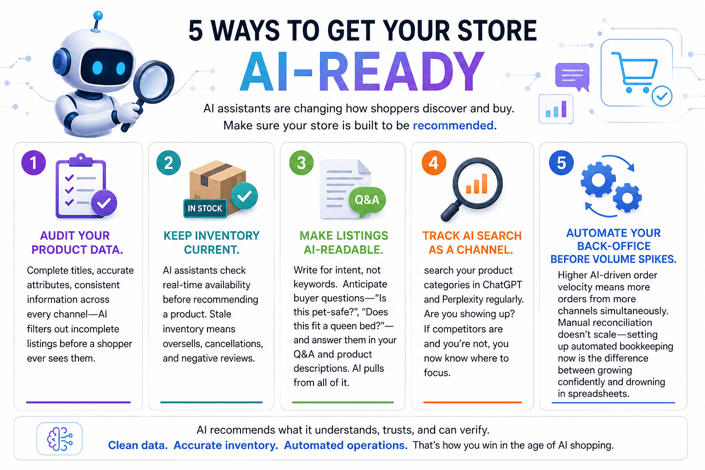
5 ways to prepare your store for AI shopping.
The zero-click buyer is already here- are you ready?
The purchase journey isn't disappearing, it's being compressed. AI doesn't favor the biggest ad budget. It favors clean data, accurate listings, and reliable fulfillment. That levels the playing field for every well-run seller.
But visibility is only half the battle. Every AI-assisted order still needs to sync, fulfill, and reconcile accurately. As order velocity grows, manual back-office processes break.
That's where Webgility comes in, automatically syncing orders, inventory, fees, and bookkeeping from Shopify, Amazon, and 70+ channels into QuickBooks, in real time.
The zero-click buyer can be your most efficient customer yet, if your operations are ready for them.
FAQs
How does zero-click buying affect sellers on Shopify and Amazon?
You still get the order, but lose website data, retargeting opportunities, cross-sell chances, and direct brand loyalty, making clean product data and strong operations more critical than ever.
How can sellers prepare for the rise of AI-assisted shopping? Keep inventory accurate, optimize listings for intent over keywords, and automate back-office operations so your business can fulfill what AI promises buyers, at any volume.
How can Webgility help sellers prepare for AI-driven shopping?
Webgility syncs orders, inventory, fees, payouts, and accounting so sellers can manage AI-driven order volume accurately.
.png?width=128&name=image%20(1).png)