.png?width=96&name=image%20(9).png)
|
Key Takeaways:
|
|
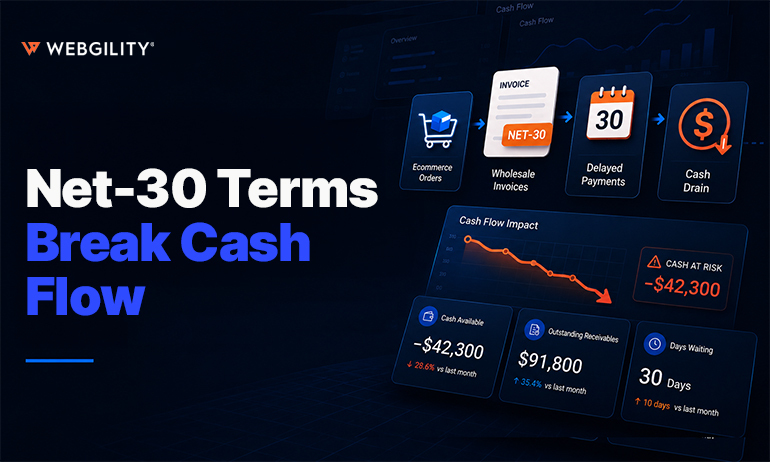
What is Net-30? “Net-30 payment terms mean the buyer has 30 days from the invoice date to pay in full. For ecommerce brands selling wholesale alongside DTC, this creates a predictable cash timing gap. The revenue is recorded the day the order ships, but cash from wholesale invoices arrives 30 – 45+ days later, while payroll, ad spend, and inventory costs run on a completely different clock.” |
You're not running out of cash because sales are slow. You've already earned the money, it just hasn't arrived yet!
For ecommerce brands running both wholesale and DTC channels, Net-30 payment terms create a recurring cash timing gap, not a one-time issue. Revenue is recorded the day the order ships, but cash from wholesale invoices arrives 30–45+ days later, while payroll, ad spend, and inventory costs run on a completely different clock.
For brands doing $1M–$10M in GMV, this is how growth stalls. Revenue climbs. The bank balance doesn't move. And it keeps getting misread as a sales problem, when it's actually a cash timing problem that becomes structurally invisible the moment you add wholesale to your ecommerce operation.
In this blog, we’ll unfold how to see it clearly, calculate, and fix it.

Where exactly does the gap start?
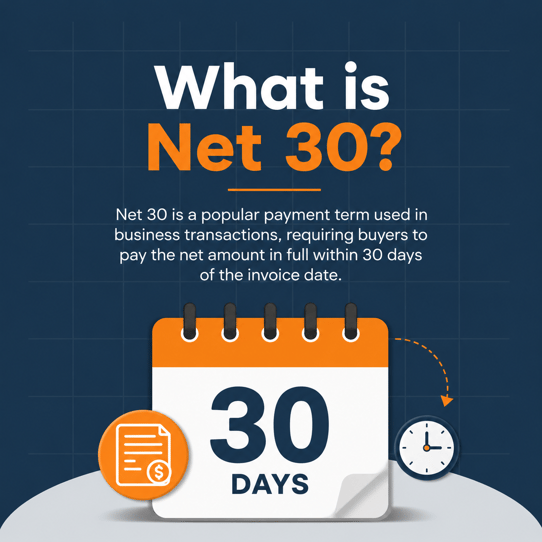
How Net-30 payment terms create a recurring cash flow gap for ecommerce brands
Net-30 terms create a structural cash gap which is recurring. What’s worse is that this gap compounds as the business grows. Here's what the timeline actually looks like across a single wholesale order:
- Day 0- Product ships. COGS is spent. Inventory is gone. (The cash is out. The revenue is recorded but it's receivable, not spendable)
- Day 1–30- Your operating costs don't wait. (Payroll runs, ads keep spending., platform fees hit, restock is needed: none of this pauses for your wholesale buyer)
- Day 30–45- Payment arrives. (Most retail partners pay at day 35–42 in practice, not day 30. Build that buffer in. The invoice due date is not the collection date).
Now multiply that by 3 – 5 open invoices running simultaneously. The gap doesn't stay the same size, it grows with every new wholesale relationship you add.
The multichannel problem: If you're running both ecommerce and wholesale, it's worse. Marketplace settlements and wholesale receivables often live in disconnected systems, making real-time cash visibility difficult. The result is a working capital problem that's invisible until it's urgent.
How DTC and wholesale cash timing actually differ
QuickBooks records all three channels as revenue immediately. But only one creates immediate liquidity. Here's what the timing actually looks like side by side:
|
Channel |
Revenue Recorded |
Cash Received |
Spendable Today? |
|
Shopify DTC |
Same day (accrual basis) |
2 – 5 business days |
Largely yes |
|
Amazon FBA |
Same day (accrual basis) |
20+ days (14-day settlement cycle + 7 day hold + ACH) |
Delayed |
|
Wholesale / Net-30 |
Same day (accrual basis) |
30 – 60+ days later |
No |
The reality: QuickBooks isn't doing anything wrong here, it's recording revenue accurately. The problem is that revenue recorded is not the same as revenue received. When you're managing all three channels from the same dashboard, that distinction disappears.
Warning signs your business has a Net-30 cash flow problem
The cash flow gap rarely announces itself cleanly. It shows up disguised as something that looks like a different problem:
Watch for these signals
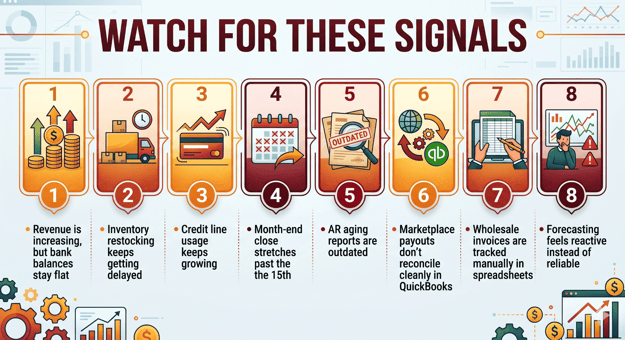
Operational signs that your business may have a hidden Net-30 cash flow problem
- Revenue is increasing, but bank balances stay flat
- Inventory restocking keeps getting delayed
- Credit line usage keeps growing
- Month-end close stretches past the 15th
- AR aging reports are outdated
- Marketplace payouts don’t reconcile cleanly in QuickBooks
- Wholesale invoices are tracked manually in spreadsheets
- Forecasting feels reactive instead of reliable
The issue often gets misread as a sales problem or a growth problem. However, it's only cash timing and visibility problems, and it doesn't go away by selling more.
Three people, one problem, different pain
The same gap hits differently depending on where you sit in the business.
Founder
The reality: “I can’t hire or reorder inventory because $80K is sitting unpaid in open invoices.”
How it hits: Founders feel the problem operationally. Decisions stall because cash is technically earned but not available. Growth starts creating stress instead of confidence.
CFO / Finance Lead
The reality: “Our working capital ratio looks fine on paper, but operations constantly feel stretched.”
How it hits: Finance teams see the mismatch between profitability and liquidity. The P&L may look healthy while cash availability tells a completely different story. Without real-time visibility into payouts, receivables, and settlement timing, forecasting becomes reactive instead of strategic.
Bookkeeper / Accountant
The reality: “I can’t close the month until the wholesale payouts reconcile, which takes until the 15th.”
How it hits: Marketplace settlements don’t align with deposits. Wholesale payments arrive partially or late. Manual reconciliation creates delays, errors, and constant spreadsheet cleanup. It means the founder is making decisions on last month's numbers for half of this month. You're not behind because you're slow. You're behind because the data isn't there.
More precisely, the data exists and never meets. Settlement files sit with the marketplace, invoice ageing sits in QuickBooks, and payout schedules sit with the processor, and most finance teams bring in data analytics consulting at exactly this point, so a cash position becomes something you read on a Tuesday instead of rebuilding on the fifteenth.
|
The problem that is common: Different teams experience different symptoms of the same underlying issue: disconnected financial visibility. |
Why this problem gets worse as you scale
At $1M GMV, the gap is manageable. At $3M–$5M, running Shopify alongside Amazon alongside a wholesale account, it stops being manageable.
Every channel you add brings a new payout schedule. Every wholesale buyer operates on different terms. Every platform reconciles differently. The complexity of tracking real cash position grows faster than the revenue does.
Businesses managing B2B invoices, DTC orders, marketplace payouts, partial payments, and inventory across channels are essentially running two or three separate cash timing problems at once. Most don't know it because each one looks small on its own.
This is why many growing ecommerce brands end up operating with profitable sales but unhealthy cash flow. The business appears successful externally while internally, cash availability becomes increasingly unpredictable.
How to calculate your cash timing gap
Before you fix the problem, put a number on it. Here's a formula most ecommerce finance teams don't use but should:
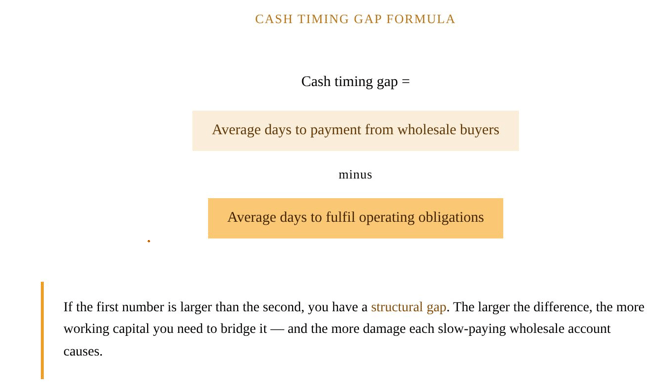
To find your average days to payment: pull your AR aging report and calculate the average actual payment date across your last 10 closed wholesale invoices. Not the due date, the date cash cleared your bank. For most brands, this lands at 35–42 days, not 30.
6 ways to close the gap
These are ranked by speed of impact, not by complexity:
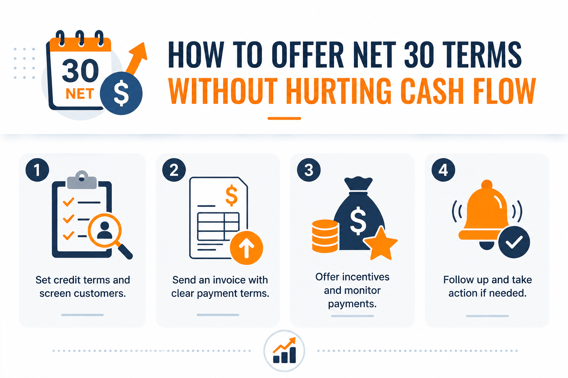
Steps to offer Net-30 terms without hurting cash flow
1. Tighten invoice terms now
Offer 2/10 Net-30, a 2% discount if the buyer pays within 10 days. Most buyers who can pay early will. It costs you 2% on those invoices and buys you 20 days of cash. That's not a discount. That's a working capital tool.
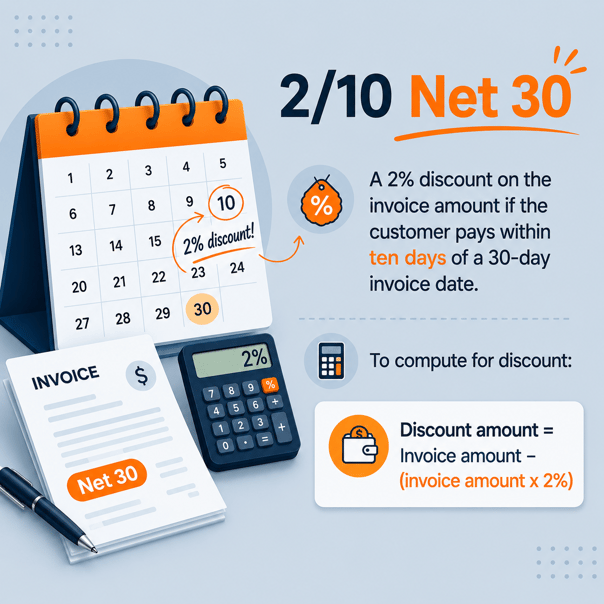
How 2/10 Net-30 discounts encourage faster payments
2. Automate invoice follow-up before payment go overdue
Most late payments aren't disputes, they're forgotten. An automated reminder at Day 15, Day 25, and Day 30 recovers a significant amount of AR without a single uncomfortable conversation. If you're not doing this today, start this week.
3. Unify ecommerce and wholesale receivables into one real-time view
The gap is manageable when you can see it. When your Shopify payouts, Amazon settlements, and wholesale invoices all live in different places, you can't see it, until it's a crisis. A single real-time AR view changes what decisions you can make and how fast you can make them.
4. Use invoice financing as a bridge
A revolving line of credit or invoice financing against open AR is a legitimate tool for businesses with predictable payment cycles. The goal isn't to rely on it permanently, it's to stop a known cash timing gap from becoming an operational emergency.
5. Segment your buyers by payment reliability
Your fastest payers should get your best terms. Your slowest payers should get tighter ones. If you don't know who your three slowest-paying wholesale accounts are right now, that's the first number to find.
6. Reduce manual accounting delays
Manual reconciliation creates reporting delays. When settlements, invoices, fees, and deposits are matched by hand, finance teams are always working with outdated information. Reducing that lag improves AR accuracy, month-end close speed, and cash forecasting confidence. For bookkeepers, cleaner integrations mean less spreadsheet cleanup and faster closes.
Why your current tools are making this worse
The gap persists because your ecommerce data, wholesale invoices, and accounting live in separate systems that were never designed to talk to each other.
QuickBooks alone doesn't see marketplace payouts in real time. Amazon deposits a net settlement; one number, with no breakdown of fees, returns, or adjustments. Your wholesale invoices live in a spreadsheet that doesn't connect to anything. Reconciliation is manual, which means it's slow and slow means it's always a few weeks wrong.
When your bookkeeper can't close the month until the 15th, your founder is making restock and hiring decisions on last month's numbers. That's not a bookkeeping problem. That's a visibility problem.
Webgility keeps ecommerce payouts, wholesale receivables, and settlement activity separated and posted automatically into QuickBooks: every order, every fee, every invoice as an individual classified record. Nothing as a lump sum. That gives founders and finance teams a clean, current cash view without relying on manual reconciliation.
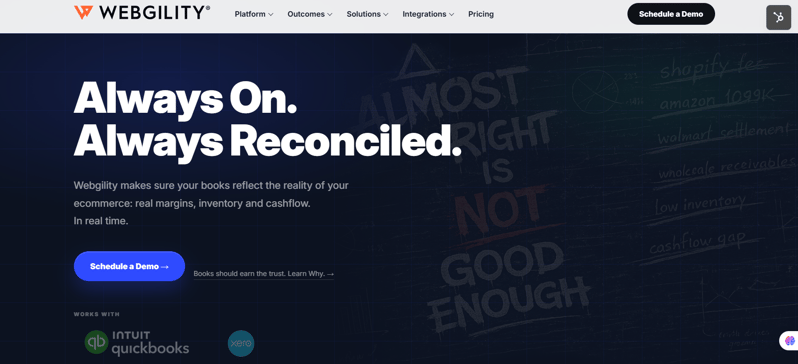
Webgility dashboard highlighting real-time ecommerce reconciliation and cash flow visibility
What this looks like in practice: Channie's was selling across Amazon, eBay, and Walmart with manual reconciliation that couldn't keep up. After connecting all three channels through Webgility, the team saved two hours a day on order processing, scaled to 10,000+ orders per month, and grew revenue from $1.9M to $5.5M, without adding accounting headcount.
Act now!
Pick the action that matches where you sit:
If you’re a Founder / Owner-
Pull your 90-day AR aging report today. Add up what's sitting unpaid. If it's more than one month of operating expenses, you have a cash timing problem, not a revenue problem.
If you’re a CFO / Finance Lead-
Map average days-to-payment by wholesale buyer. Identify your three slowest payers. Calculate what accelerating even one of them by 15 days would do to your available cash this quarter.
If you’re a Bookkeeper / Accountant-
Flag which month-end close items are blocked by Net-30 reconciliation. Put a number on how many days that delay pushes your close; that's exactly how long your founder is operating without current data.
The reason these actions are hard is the same reason the gap exists: your channels, invoices, and accounting aren't talking to each other. Webgility's team of experts will walk through your channels, accounting setup, and close process and surface exactly where the cash timing gap is hiding, in 30 minutes.

FAQs
How do ecommerce payouts affect Net-30 cash flow?
Marketplace payouts follow different schedules than wholesale invoices. This creates fragmented cash timing and makes forecasting more difficult.
Should wholesale businesses offer early payment discounts?
In many cases, yes. Small discounts for early payment can improve liquidity and reduce working capital pressure.
What is the difference between Net-30 terms and ecommerce payout timing?
Net-30 payment terms are a B2B billing agreement where a wholesale buyer has 30 days from the invoice date to pay in full. Ecommerce payout timing refers to when platforms like Shopify or Amazon deposit funds to your bank — typically within 1–14 days of a sale.
.png?width=128&name=image%20(9).png)